
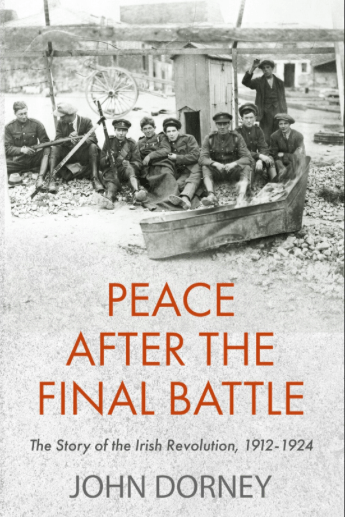
‘Peace after the Final Battle’
‘The story of the Irish Revolution, 1912-1924’ John Dorney
The intriguing title of this 376 page paperback is taken from a quote in the Irish Republican newspaper November 1910, ‘War yesterday, war today, war tomorrow. Peace after the final battle’. In ten gripping chapters rounded off by a thought provoking conclusion the historian John Dorney explores the revolutionary years between 1912 and 1924, a struggle between good and evil in which the ‘final battle’ aimed to ‘right the wrongs of Irish history, to reverse the process of colonisation. Dorney presents these times in the words of the participants both men and women, great and small because ‘a great deal of the story of Ireland’s nationalistic revolution remains basically untold’.
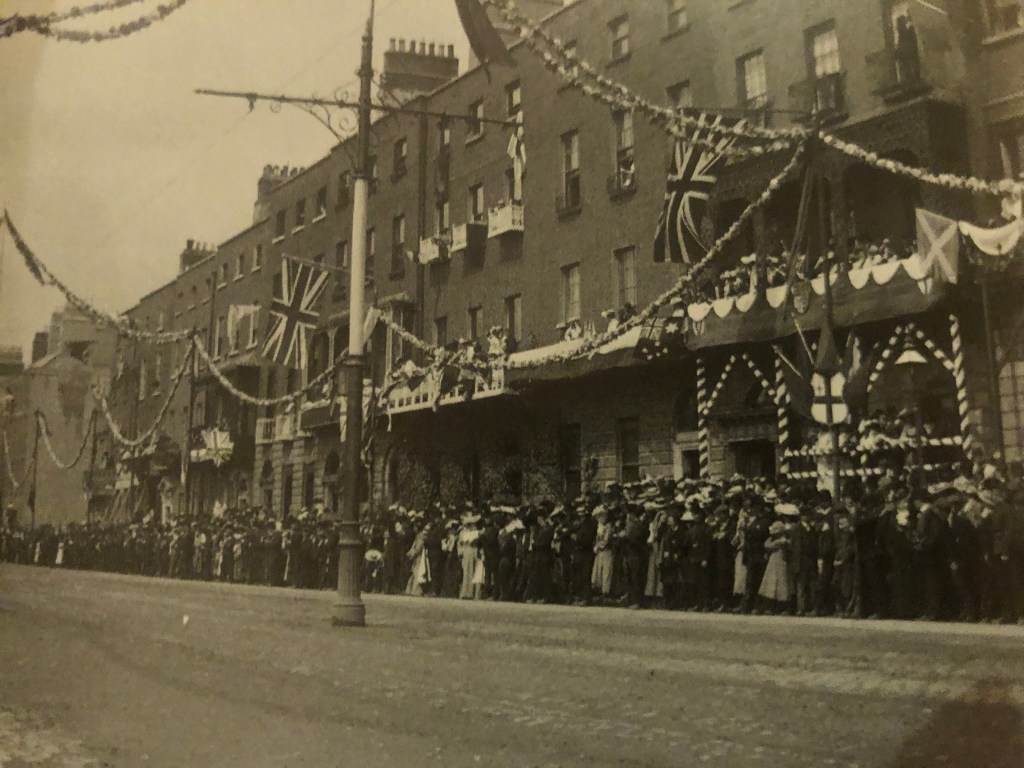
Dorney opens a door into the events before the revolution. It had been a country which welcomed royalty. Alderman J. J. Farrell, the former Lord Mayor of Dublin, declared in 1915: ‘The (British) Government do not want anything from Dublin or the south (of Ireland~) but blood and money’. He describes the consequences of the news of terrible losses at Gallipoli 1915 when the 10th Irish Division “suffered devastating casualties while trying to land on Turkish beaches with up to two-thirds of the regiment being killed or wounded. When news of the losses reached Ireland… it shook even ‘Castle Catholic’ (Catholic Unionist) Katherine Tynan. She wrote… ‘For the first time came bitterness, for we felt that their lives had been thrown away and their heroism gone unrecognised’”.
The lesser known stories of the determined struggle for independence are brought vividly to light.
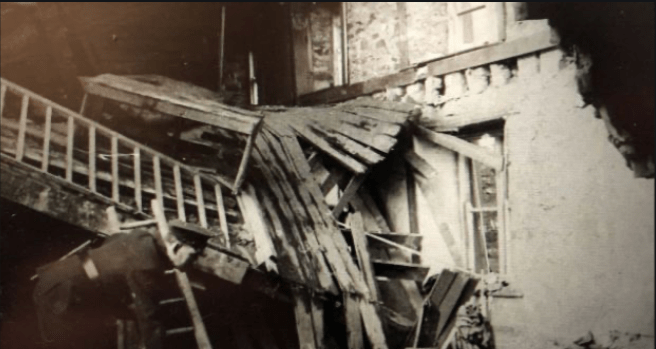
‘British Counterstroke, Aug-Dec 1920’
“On the arrival of the new police recruits, the balance of terror shifted… IRA activists found themselves arrested, beaten and shot. One of those arrested was Paul Galligan IRA commandant and TD for Cavan. Ten armed Black and Tans burst into his father’s house. His father wrote, ‘Paul was in the kitchen just after tea. Paul rushed out the back door pursued by four armed soldiers who fired several shots at him at short range. He got as far as Mc Cann’s garden gate and while in the act of opening the gate a rifle bullet went through his arm… Such savagery I never witnessed. They wouldn’t give me time to have his wound dressed or allow him into the house but dragged him into the motor and drove off’”.
The Black and Tans and Auxiliaries, Dorney explains were not police and had no training in normal police work. “One regular RIC man remembered, ‘a country inspector in the barracks…asked this fellow, ‘If you seen a man on the street and asked his name and address and he refused, what would you do?’ And the Black and Tan said…’I would lift him under the jaw and the next thing I would use my bayonet’”.

Dorney does not shirk from the bitterness of the Civil War. In September 1922 the Public Safety Bill was passed. “Executioners needed only the signatures of two National army officers. Cosgrave told the Dáil, ‘Although I have always objected to the death penalty, there is no other way that I know of in which ordered conditions can be restored in this country’”.
“Liam Lynch ordered the killing of any TD who had voted for the ‘Murder Bill’ and also threatened hostile judges and newspaper editors. The war had entered its darkest phase, with all the malicious bitterness of a vendetta”.
A thought provoking conclusion challenges. Dorney recounts how ‘the blocking of the long-promised Home Rule in 1912-14 incensed moderate Irish nationalists and compromised the legitimacy of the British state in Ireland’. He reveals how ‘Unusually for revolutions… the end of the Irish revolution was negotiated’. He reminds that in the 1930s a protected Irish industrial base was established as well as some social housing and welfare measures. He counters that they did not only paint ‘the post boxes green’ but he believes that the Irish Revolution marked a real end to the old order of British rule in Ireland and was ‘a true turning point in Irish history’.
John Dorney has a website ‘The Irish Story’ and also wrote ‘The Civil War in Dublin: The Fight for the Irish Capital, 1922-1924’.
This book is available at the following links below:
www.amazon.co.uk (Kindle version)

 Easter Rising Stories