“Searching For Sean” Book of the Week

‘Searching for Seán: Remembering Sean Treacy 100 Years On’ 
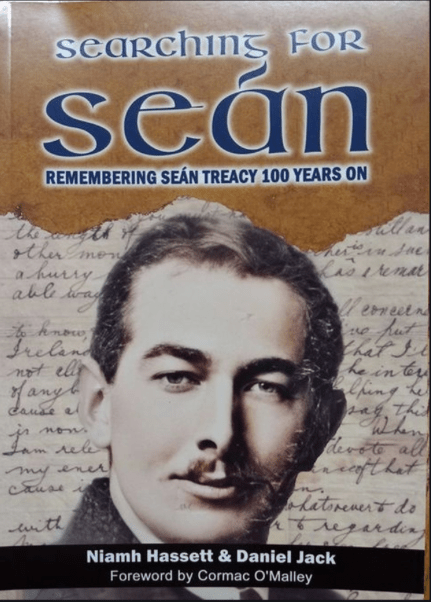
This 160 page commemorative publication takes a fresh look at a man dubbed ‘The Greatest Fighter in Ireland’. Written by Niamh Hassett, daughter of the renowned late historian, John Hassett, and Daniel Jack, relative of Séumas Robinson who fought alongside Treacy and Dan Breen, it also features an insightful foreword by Cormac KH O’Malley, son of Ernie O’Malley, Seán’s friend and comrade in arms. Cormac states, ‘These men all knew the struggle that lay ahead of them, the personal and physical sacrifices… but there was an over-riding objective –  an Ireland free of English control and an Ireland ruled by Irish men and women’.

This accessible publication covers Treacy’s early life and influences, major events in the struggle for Irish freedom including Soloheadbeg, Knocklong, daring attacks on barracks, the dramatic escape in Drumcondra and the tragic shoot-out in Talbot Street, Dublin in 1920. Both well- known freedom fighters and lesser-known characters lend their voices to the exciting narrative. Contemporary newspaper accounts and Treacy’s own words bring to life the dramatic struggle for freedom.
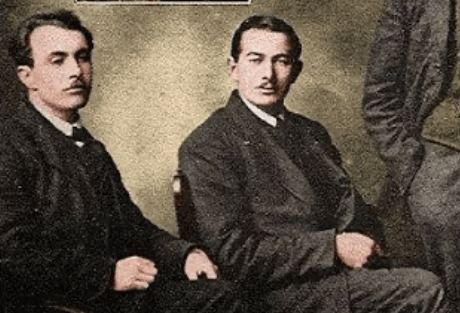
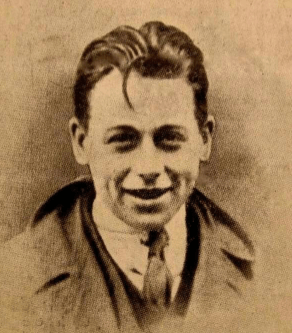
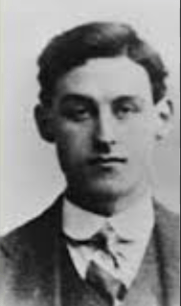
Seumas Robinson & Sean Treacy

Treacy’s force of character is recalled by his great friend and comrade, Dan Breen, ‘To Treacy any problem submitted was never approached as “Can it be done?” but rather “How can it best be done?”’ Although he had been bitterly disappointed by the inaction in the Tipperary region in 1916, because of Eoin MacNeill’s countermanding order, he was determined to hold the thread of an organisation together. His home became ‘a nest of cunning hiding places for military equipment and secret documents’. He studied military manuals and soon acquired a reputation for experimenting with explosives.

Always one to use time productively, when arrested in Tipperary town for taking part in a rally for Eamon De Valera, he spent his days in Mountjoy Prison studying Irish, shorthand, military matters and extending his knowledge of explosives. Re-arrested and incarcerated in Dundalk Gaol, he began a hunger strike to enact the conditions for prisoners won in Mountjoy. Treacy’s own words highlight his sterling personality. He wrote to his comrade Maurice Crowe instructing him to begin guerrilla warfare in South Tipperary, ‘Take the enemy by surprise. Hit first and don’t let him hit you. Burn barracks. Use gelignite bombs if procurable. Show no mercy to resisters’.

34 black and white photos featuring his home, school, important documents, local newspaper accounts, planning maps, important characters and memorabilia, bring the Treacy story into sharp focus, vividly forging the strong link between Tipperary and  Dublin in the life of the ‘cool, calm and collected figure of Seán Treacy’.  His analytical account of the attack on Holyford is included, ‘Attack on barracks commenced about 3am with 8 rifles…on the roof threw in grenades and fired through roof. Peelers driven out of half of barracks and that half burned’.  He candidly details the causes of the failure of the attack, ‘commenced too late – about half an hour before daylight… too much shouting and threatening to peelers which may have made them afraid to surrender’.  

The action moves to Dublin. Captain Jeune, a British Intelligence officer recalls how ‘Major Smyth had come from India to avenge his brother’s murder… we went on chance to Professor Carolan’s house, Fernside, Dublin’. Dan Breen vividly describes the ferocious raid, ‘Crack! Crack! Two bullets came whizzing through the door!’ Treacy provided covering fire for Breen’s escape. The Evening Herald reported that ‘one of the men was actually suspended by one arm from a beam of wood of the conservatory roof when bullets whizzed past him’. Longing for news of Breen, Treacy went to the Republican Outfitters Store on Talbot Street. Tensions were running high in the city because of the funeral procession of Major Smyth and Captain White, both killed at Fernside. The Irish Times reported on the ‘beautiful wreath’ from their brother officers.  

Sean Brunswick saw ‘a lorry of soldiers and an armoured car’. Treacy tried to escape on a bike but Sgt. Christian identified him, ‘This is Treacy’. John Horgan, a 16 year old apprentice was trying out a camera when ‘a figure dashed from the doorway of the “Republican Outfitters”… pitifully exposed… After a few sharp staccato barks, a fusillade of firing broke out… Trembling, I sighted the prostrate form (Treacy) in the view-finder and pressed the trigger’.  Brunswick recalls how he transferred ‘ammunition, pens, dispatches and a field message book from Seán’s pockets to his own.’  Neligan, Michael Collins’s inside agent in Dublin Castle  recollects, ‘Treacy was a famous Tipperary Volunteer. He had been traced by the man who lay alongside him in death’. Seán Treacy died as he lived – fighting for Irish freedom. The book concludes with the hope that a fitting memorial will be placed at the spot where Seán gave his life for Ireland and where Tipperary fans gather when their county is in the All Ireland final. This excellently researched book recreates the passionate atmosphere where heroes ‘put Ireland over all’. 

The book is available at:

Bookworm.ie

or

Thebookmarket.ie

Here is a video of a Sean Treacy commemoration on Talbot Street in 2016
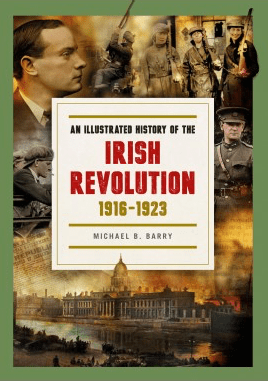
An Illustrated History of the Irish Revolution 1916-1923 Book Review

An Illustrated History of the Irish Revolution 1916-1923

Michael B. Barry

The newest instalment of Michael Barry’s visual insight into 1916-23 certainly exceeds expectations. The Irish Revolution’s difficult struggle to wring independence from the most powerful force in the world at that time, the British Empire, is told in a richly visual manner through 5 chapters; Freedom’s Long March, 1916, War of Independence, Truce and Civil War in the 368 page ‘An Illustrated History of the Irish Revolution 1916-1923 by Michael B. Barry. Skilfully colourised photographs by John O’ Byrne bring both the important personalities and ordinary people to life. Specially created maps show the complicated manoeuvres of Lowe and Barry. The nuances and details of seminal events like the killing of Michael Collins are explored while continental periodicals vividly show the struggle’s impact in other countries.

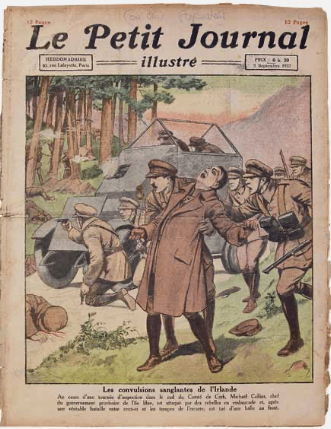
“The Bloody Convulsions in Ireland”: ‘Le Petit Journal of Paris imaginatively depicts the events and also features in Michael Barry’s book.

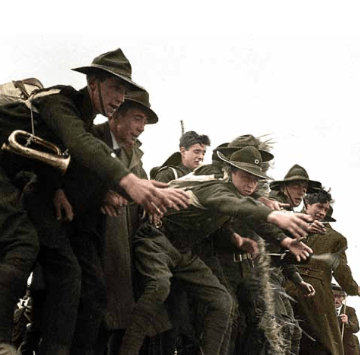
The subjugation of Ireland is traced from ‘The Marriage of Strongbow and Aoife’ to King William’s victory at the Battle of the Boyne which tightened the iron grip on Ireland. Emmet’s execution, the rise of the Fenian Brotherhood and the arming of the UVF in 1914 follow in quick succession. The enthusiasm and energy the young Fianna as the strive to help unload the precious cargo of the ‘Asgard’  is vividly depicted in colour. A detailed map shows the tight cordon set up by the British General W. Lowe when he positioned 4,600 troops to surround the Irish garrisons in 1916. Their positions are circled in red. The heavy cost of the struggle is depicted in heart-wrenching illustrations of the funerals of two hunger-strikers, Thomas Ashe and Terence Mac Sweeny .

Fianna Eireann members on the quayside help off-load weapons from the “Asgard” in 1914. Excellent photo colonisations feature in this book from photo colorisation expert John O’Byrne.
An example of one of the numerous photo pages loaded with description from
“An Illustrated History of the Irish Revolution 1916-23”

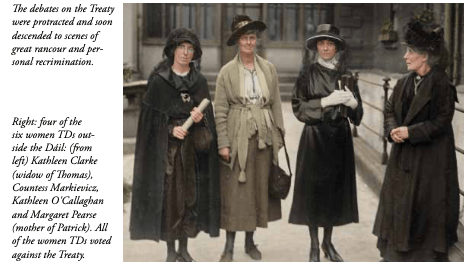
The formidable Countess Markievicz illustrates the role of women in the conflict. First shown captured in Richmond Barracks after the surrender of the Royal College of Surgeons, she then sits in a prison van after her sentence of death has been commuted to penal servitude for life. Yet she emerges triumphant after her release campaigning vigorously on behalf of Sinn Féin at the Kilkenny by-election in 1917. The important contribution of women at the dawn of the Republic is seen in the photo of 4 of the 6 women TDs outside the Dáil who all voted against the Treaty. 

Excerpt from An Illustrated History of the Irish Revolution 1916-23

A lesser known Sinn Féin plot to spread typhoid among British troops in the War of Independence is graphically illustrated . Both Mulchay and Collins regarded it as a ‘joke’ and it was about to go into the waste paper basket when a raid occurred. The British were not believed when they levelled charges about the plot because they had form in spreading black propaganda. Bloody Sunday soon eclipsed this story. 

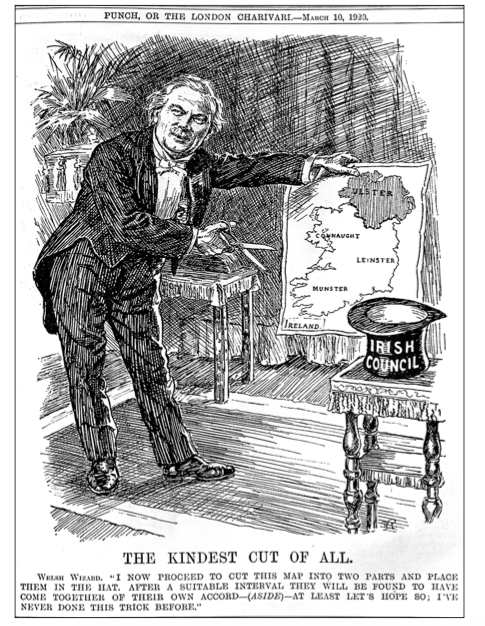
Contemporary cartoons provide a sharp commentary on events. Lloyd George’s 1920 partition trickery, giving the Unionists precisely what they wanted reverberates to this day. The savage Civil War is bright into sharp focus when Government troops pose outside the Granville Hotel with a mine which they have just disabled. A series of photographs of derailed locomotives and blown-up bridges show the devastation of the times. The stunning Ballyseedy Monument depicts the lowest point of the war when nine prisoners were blown up with a mine by the Free Staters. General Mulcahy salutes at the stand-down ceremony and the book concludes with a quiet image of the most visited grave in Glasnevin.

Lloyd George cartoon showing his trickery from Punch magazine in March 1920
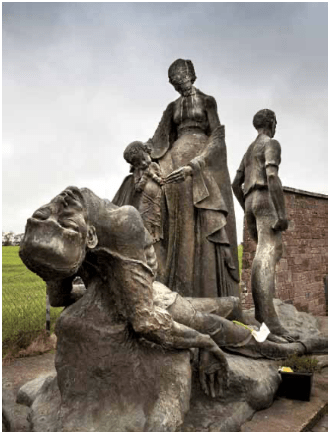
The Ballyseedy Monument by the Breton sculptor, Yann Renard Goulet, unveiled in 1959. This tortured statue is one of the most dramatic sculptures in Ireland and aptly remembers the appalling atrocity that took place here. (Excerpt from An Illustrated History of the Irish Revolution 1916-23)

Barry created this impressive work which contains 800 images after ten years of careful research at home and abroad. He details the events of the Irish struggle for independence sequentially and includes a useful timeline and comprehensive glossary and bibliography.  An enjoyable read, this accessible visual feast would appeal not only to young history students who are discovering these events for the first time, but also to those who need a scholarly reference book for Irish history. Barry’s keen eye is honed by his background in engineering. The Irish academy of engineering has awarded him for his ‘outstanding contribution o engineering heritage in Ireland.’

His other books include the trilogy: ‘Courage Boys, We are Winning, an Illustrated History of the 1916 Rising’, ‘The Fight for Irish Freedom, an Illustrated History of the War of Independence’ and ‘The Great Divide, an Illustrated history of the Irish Civil War’.

Available from books.ie and Bookdepository.com   and Easons.com

Easter Rising Stories Book of the Week “Peace After The Final Battle The Story of the Irish Revolution 1912-1924”

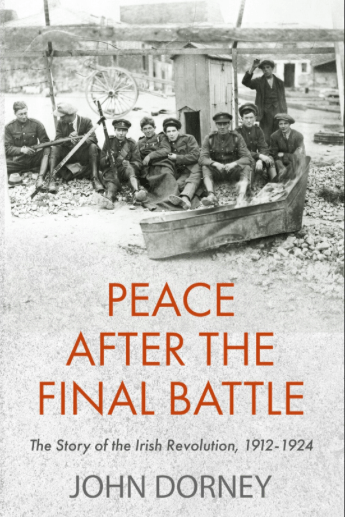
‘Peace after the Final Battle’

‘The story of the Irish Revolution, 1912-1924’ John Dorney

The intriguing title of this 376 page paperback is taken from a quote in the Irish Republican newspaper November 1910, ‘War yesterday, war today, war tomorrow. Peace after the final battle’. In ten gripping chapters rounded off by a thought provoking conclusion the historian John Dorney explores the revolutionary years between 1912 and 1924, a struggle between good and evil in which the ‘final battle’ aimed to ‘right the wrongs of Irish history, to reverse the process of colonisation. Dorney presents these times in the words of the participants both men and women, great and small because ‘a great deal of the story of Ireland’s nationalistic revolution remains basically untold’. 

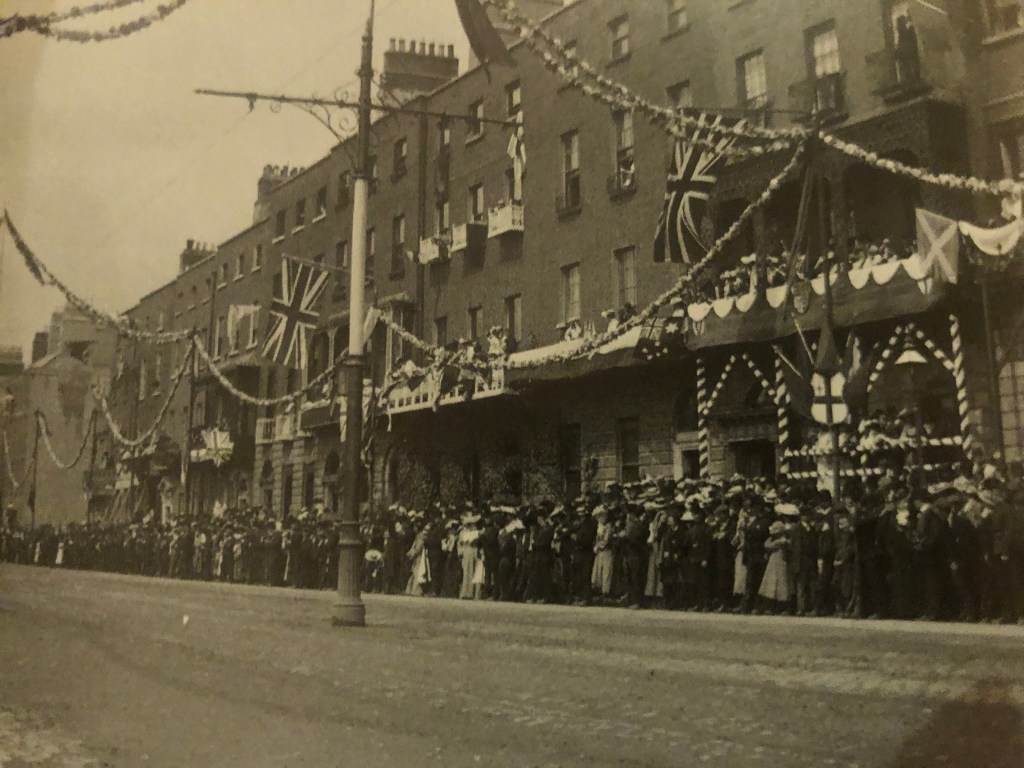
Crowds gather in Merrion Square, Dublin to welcome the Royal Visit of King George V in 1911. 5 years later the 1916 Rising would occur.

Dorney opens a door into the events before the revolution. It had been a country which welcomed royalty. Alderman J. J. Farrell, the former Lord Mayor of Dublin, declared in 1915: ‘The (British) Government do not want anything from Dublin or the south (of Ireland~) but blood and money’. He describes the consequences of the news of terrible losses at Gallipoli 1915 when the 10th Irish Division “suffered devastating casualties while trying to land on Turkish beaches with up to two-thirds of the regiment being killed or wounded. When news of the losses reached Ireland… it shook even ‘Castle Catholic’ (Catholic Unionist) Katherine Tynan.  She wrote… ‘For the first time came bitterness, for we felt that their lives had been thrown away and their heroism gone unrecognised’”. 

The lesser known stories of the determined struggle for independence are brought vividly to light.

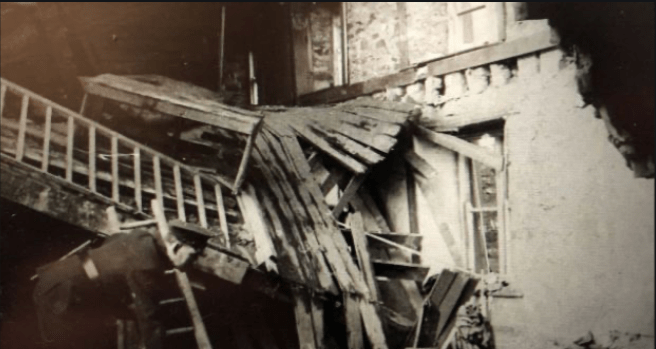
RIC barracks at Ballytrain County Monaghan which was hit with an IRA bomb in February 1920. Numerous attacks were made on police barracks around Ireland that year.

‘British Counterstroke, Aug-Dec 1920’ 

“On the arrival of the new police recruits, the balance of terror shifted… IRA activists found themselves arrested, beaten and shot. One of those arrested was Paul Galligan IRA commandant and TD for Cavan. Ten armed Black and Tans burst into his father’s house. His father wrote, ‘Paul was in the kitchen just after tea. Paul rushed out the back door pursued by four armed soldiers who fired several shots at him at short range. He got as far as Mc Cann’s garden gate and while in the act of opening the gate a rifle bullet went through his arm… Such savagery I never witnessed. They wouldn’t give me time to have his wound dressed or allow him into the house but dragged him into the motor and drove off’”.

The Black and Tans and Auxiliaries, Dorney explains were not police and had no training in normal police work. “One regular RIC man remembered, ‘a country inspector in the barracks…asked this fellow, ‘If you seen a man on the street and asked his name and address and he refused, what would you do?’ And the Black and Tan said…’I would lift him under the jaw and the next thing I would use my bayonet’”.

A Free State propaganda photo regarding a staged execution of Rory O’Connor.

Dorney does not shirk from the bitterness of the Civil War. In September 1922 the Public Safety Bill was passed. “Executioners needed only the signatures of two National army officers. Cosgrave told the Dáil, ‘Although I have always objected to the death penalty, there is no other way that I know of in which ordered conditions can be restored in this country’”. 

“Liam Lynch ordered the killing of any TD who had voted for the ‘Murder Bill’ and also threatened hostile judges and newspaper editors. The war had entered its darkest phase, with all the malicious bitterness of a vendetta”.

A thought provoking conclusion challenges.  Dorney recounts how ‘the blocking of the long-promised Home Rule in 1912-14 incensed moderate Irish nationalists and compromised the legitimacy of the British state in Ireland’. He reveals how ‘Unusually for revolutions… the end of the Irish revolution was negotiated’. He reminds that in the 1930s a protected Irish industrial base was established as well as some social housing and welfare measures. He counters that they did not only paint ‘the post boxes green’ but he believes that the Irish Revolution marked a real end to the old order of British rule in Ireland  and was ‘a true turning point in Irish history’.

John Dorney has a website ‘The Irish Story’ and also wrote ‘The Civil War in Dublin: The Fight for the Irish Capital, 1922-1924’.

This book is available at the following links below:

www.newisland.ie      

www.amazon.co.uk (Kindle version)

www.bookdepository.com

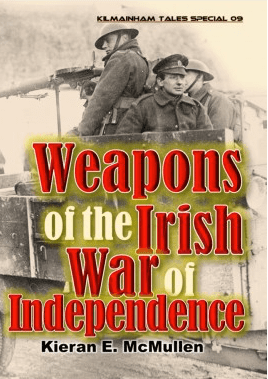
Easter Rising Stories Book of the Week: Weapons of the Irish War of Independence”

Weapons of the Irish War of Independence

Kieran E. Mc Mullen

Have you ever considered the crucial importance of weapons in the amazing struggle for freedom in Ireland? Let Kieran McMullen, retired army Lieutenant colonel of field artillery, veteran of Operation Desert Storm and Korean DMZ, guide you in his book, ‘Weapons of The Irish War of Independence’, from Kilmainham Tales.

Illustration Pg. 8

Kieran Explains how the Crown Forces were well armed with every weapon they could need and plentiful supplies of ammunition while The Irish struggled, stealing, importing, smuggling guns often hidden in bags of oats from Belfast. Handguns, both revolvers and semi-automatics, were the preferred weapons in the cities. The long gun was the weapon of choice in the countryside. 

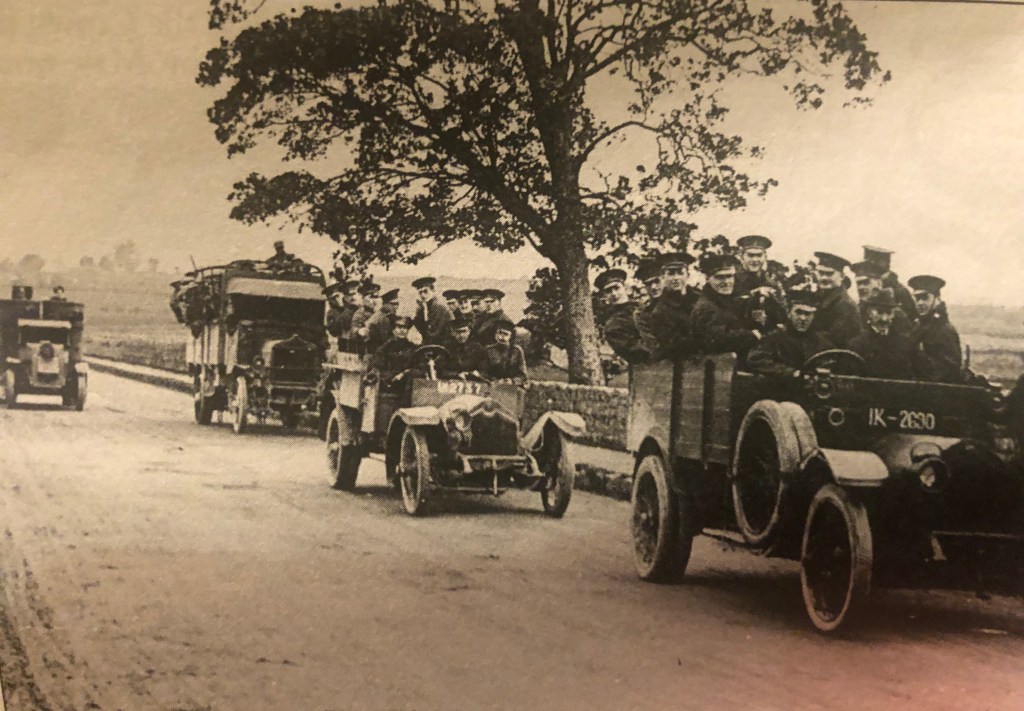
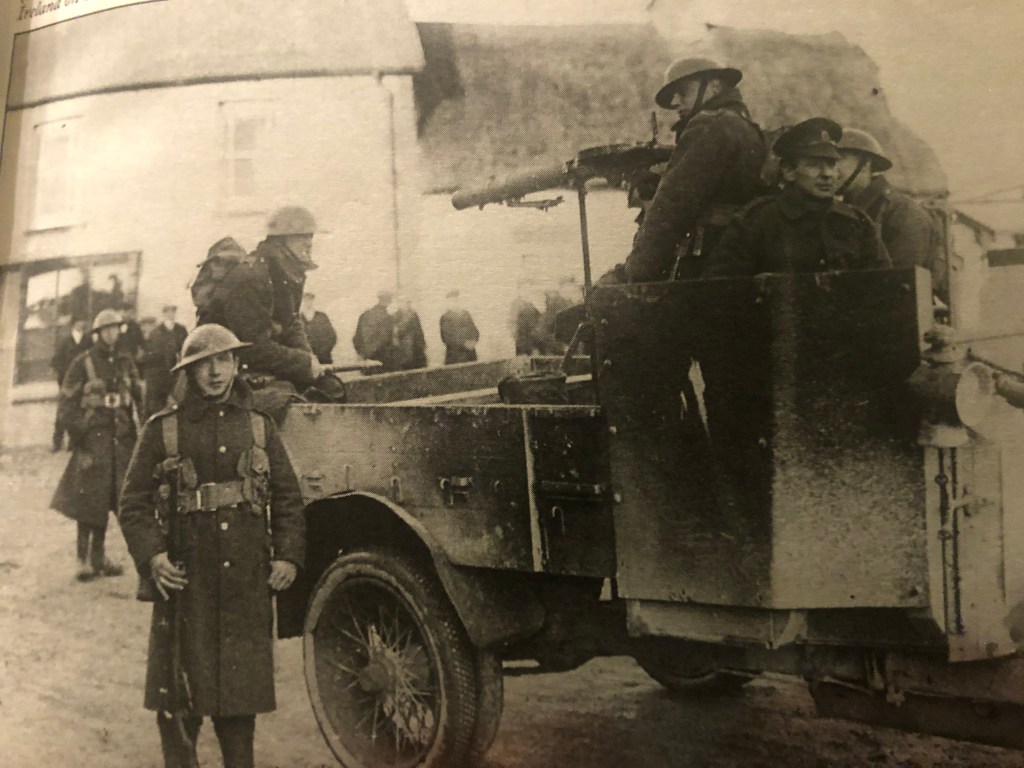
The British introduced the armoured car onto the streets of Dublin in 1916, a cobbled-together quick fix of Guinness lorries and railroad boilers crushing ‘through the doors of Irishmen. 

Kieran, a trained shooting firearms instructor with a long career in law enforcement, vividly describes how shortage of ammunition led the Irish to ‘point and shoot’ rather than ‘aim and fire’. Not for them the luxury of firearms practice. They had to take whatever weapon they were given.  

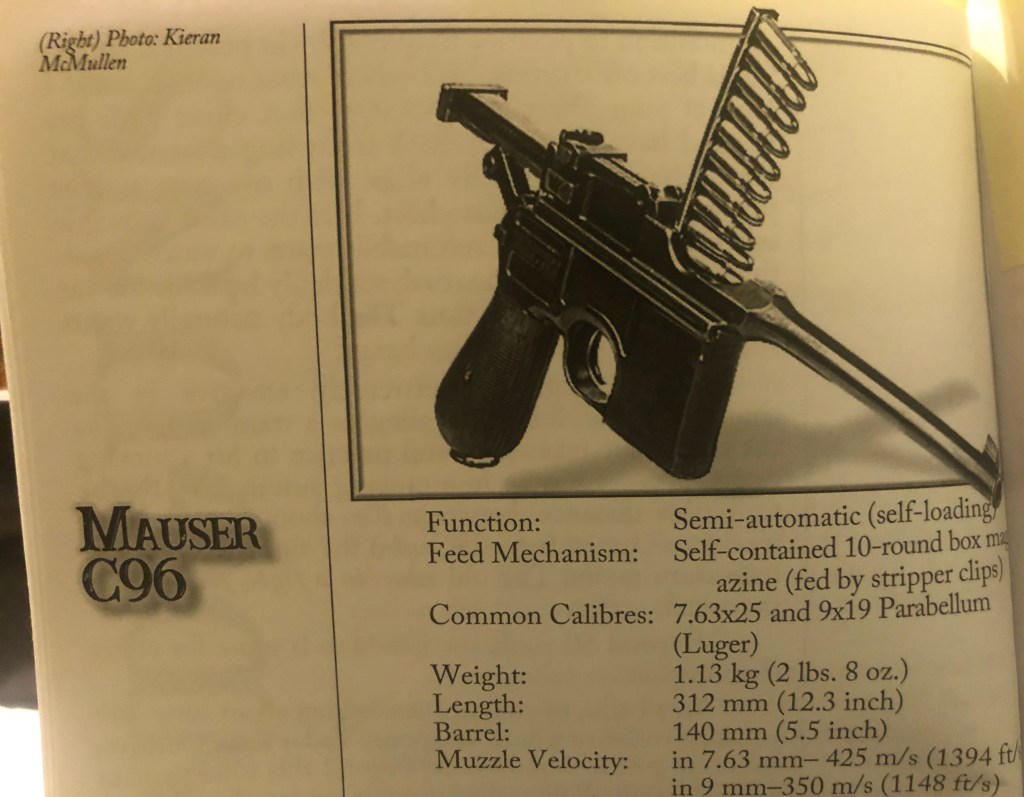
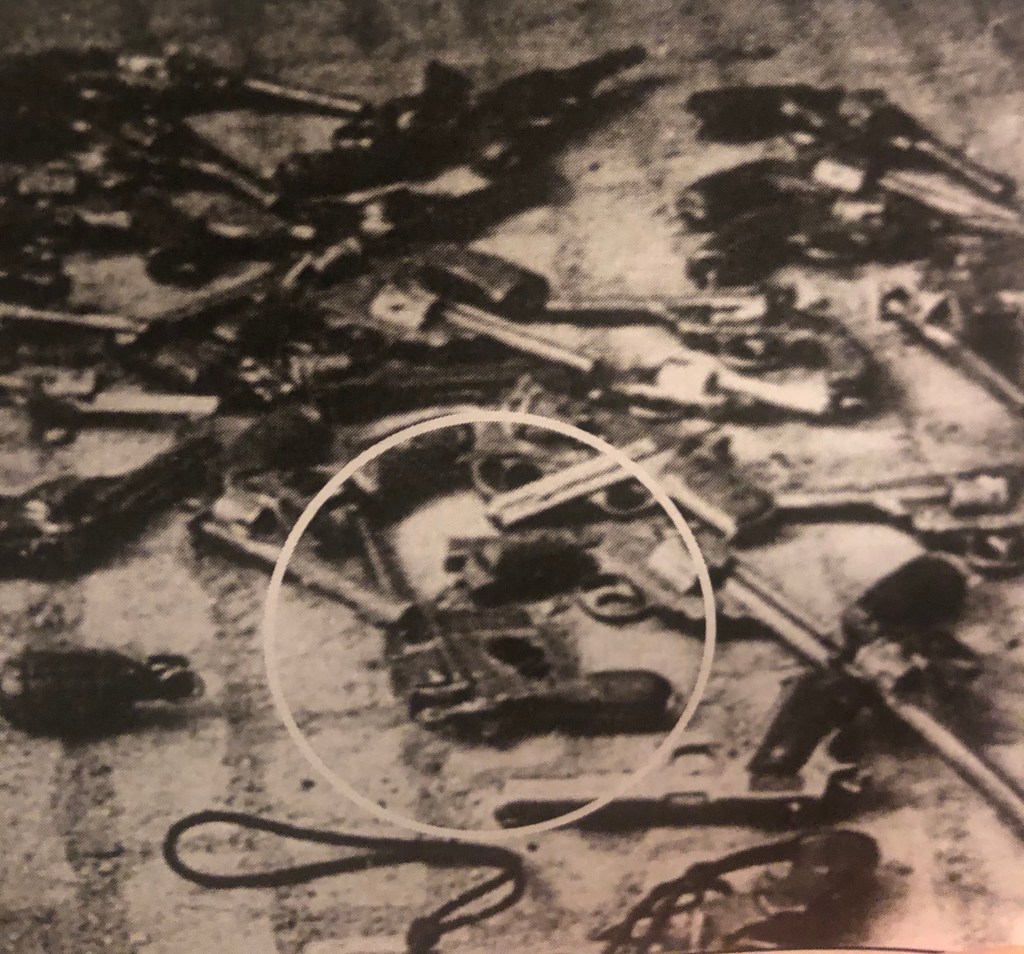
The famous ‘Peter the Painter’, Mauser C96, Kieran reveals was named after the Latvian anarchist who outgunned the London Metropolitan Police at the famous Siege of Sydney Street. Cathal Brugha selected it when he went to the visitors’ gallery in the House of Commons in April and June of 1918. Vinnie Byrne of ‘The Squad’ used it to execute two British Intelligence officers on Bloody Sunday.

Here is a picture of the weapon Byrne threw down before his capture at the Burning of the Customs House.  It was also chosen by Ernie O’Malley when he went round Ireland as GHQ Organiser.

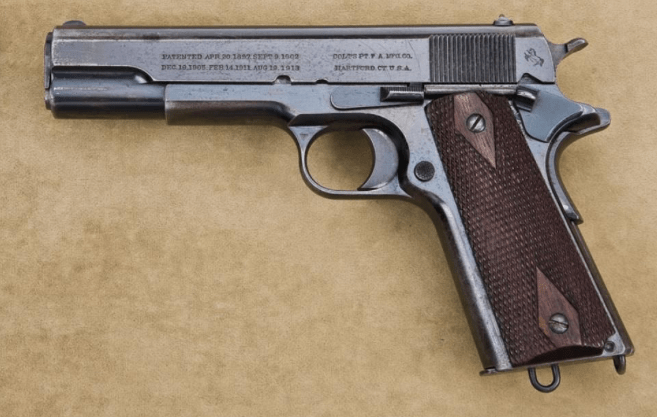
The Colt Model 1911 is ‘one of the safest hand-guns in the world’. One of executed leader Joseph Plunkett’s brothers carried it. This gun was a favourite with the British Army Officers and became a prize to be taken by the IRA in ambushes or raids. Sean Doyle took one from under the pillow of a British officer who was an unfortunmate casualty of Bloody Sunday.

Plunkett had a close call after a daring raid on a mail van. Standing in Peadar Clancy’s shop in Talbot Street, with the pistol tucked into his waistband, he was suddenly surrounded by a raiding party of Military and DMP. There was no back door. Quick-thinking Clancy calmly asked the officer in charge if he could finish serving his ‘customer’, Plunkett. He wrapped up a couple of shirt collars and told his ‘customer’ that he could pay another time. 

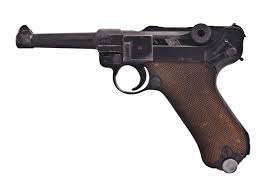
Another infamous firearm was the Parabellum P-08 or Luger, the standard firearm of the German Army. However it is susceptible to dirt and sensitive to ammunition. If the ammunition is too ‘hot’ the toggle moves too quickly and the cartridge… may become jammed in the chamber, causing failure to extract or feed a new round’. 

Kevin Barry arrived late for the Ambush at Monks’ Bakery and was issued with a Parabellum. He ‘was not happy’. When they held up the lorry, they were outnumbered, 20 to 13. The Volunteers withdrew and regrouped in Cathedral Street only to discover Barry was missing. ‘Kevin’s gun jammed and he went down under the lorry to fix it. Only one shot fired… if you have not all the ammunition with the same mark and date it causes a jam’. Barry was captured and subsequently executed.

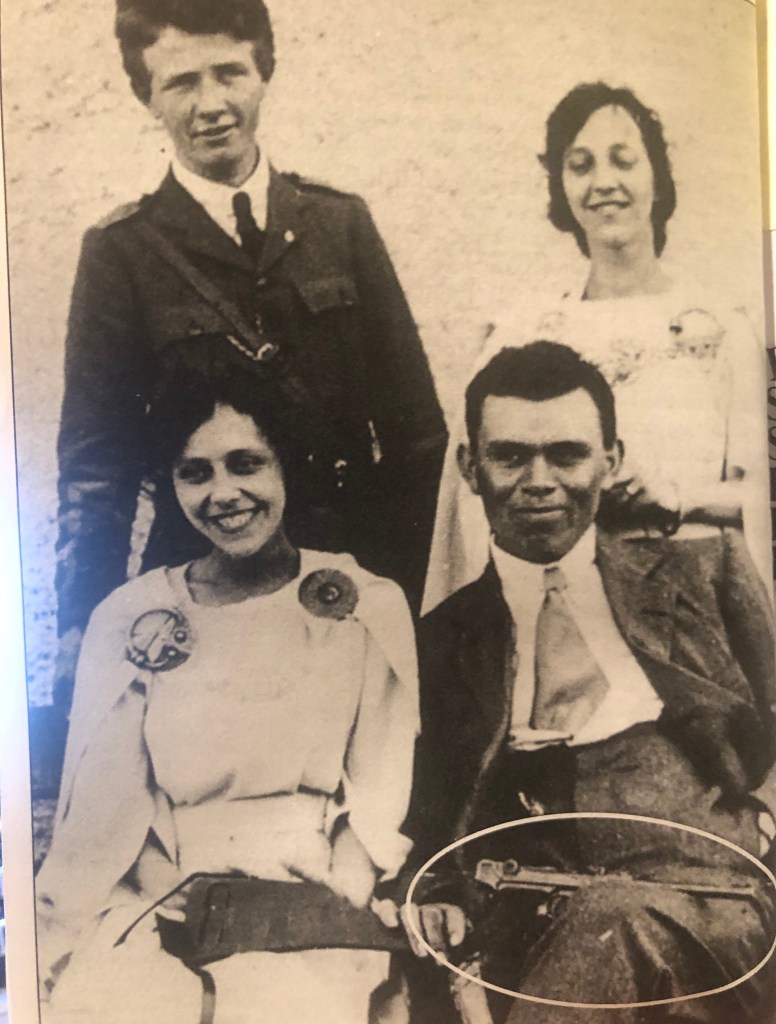
Dan Breen proudly displays his Artillery Model Luger at his wedding to Brigid Malone.

Kieran’s encyclopaedic knowledge of historical weapons and his comprehensive knowledge of Irish history result in an accessible fascinating insight into the weapons used on all sides in the bloody struggle for Irish Independence 1916-21. 

Available from Kilmainham Tales.http://kilmainhamtales.ie/kts-09—weapons-of-the-irish-war-of-independence.php

Available from http://www.books.ie/weapons-of-the-irish-war-of-independence

Easter Rising Stories Book of the Week: Killing At Its Very Extreme

Welcome to Easter Rising Stories Book of the Week 

‘Killing At Its Very Extreme’

by Derek Molyneux and Darren Kelly is published by Mercier Press. This is the third book of their successful series. Their first book “When The Clock Struck in 1916” is simply the best book on the 1916 Rising which looks at in detail, battle by battle the close combat surrounding the city of Dublin. Their second book Those of Us Who Must Die looks at the treatment of and execution of the 1916 leaders as well as the conditions the Irish Volunteers found themselves in upon arrest. 

So how does their third book hold up? Yet again Molyneux and Kelly have broken new ground with Killing At Its Very Extreme. This book rewrites areas which have often been overlooked, exploring the War of Independence from many new angles. As always with books by Derek Molyneux and Darren Kelly they objectively cast a cold eye on the brutality of assassinations as well as the horror of reprisals.

Urban guerrilla warfare, its ferocity, pain and terror was mercilessly perfected on Dublin’s dark, dreary streets from October 1917- November 1920. This book takes you to those streets.

It looks at the dogged tenacity of those left after the trauma of 1916 who refused to accept the detrimental rule of the greatest empire in the known world, is graphically explored in 336 pages. 

Readers become immersed in the story of Brigadier Dick McKee, a person who has been criminally overlooked in terms of his influence on the major events with the War of Independence. One example is Colonel Ormonde de l’Epée Winter, the British intelligence chief known as the ‘Holy Terror’, arrived in Ireland to build up police intelligence for the British. He was immediately embarrassed by McKee and Peadar Clancy’s daring raid on the King’s Inn building. Surprise and speed were essential. It was carried out within 7 minutes. McKee then organised another bold ambush on the weekly army payroll brought in an armoured Rolls Royce each Thursday from the Munster and Leinster Bank at Doyle’s Corner.

Richard “Dick” McKee

Lets read an extract from the book to give you a flavour of events.

William Bill O’Connell

‘Volunteer Bill O’Connell sprinted towards the car. A bullet sent him tumbling to the ground, killed before his body crashed to the cobblestones. His brains splattered the street. This did not prevent the remaining IRA men from quickly surrounding the car. They jumped on its running boards while Bernard Byrne managed to insert his pistol barrel into a gap in a hatch… He fired several shots, their deafening echoes reverberated along with the ricocheting bullets inside smashing against metal and into flesh to the sound of terrified screams and shouts from those being cut, gashed and blinded by bullet and metal fragments. The machine gun was silent. In the chaos, Charlie Byrne inserted revolver through a vision slit at the vehicle’s front, only to have the gunner wrench and wrestle the barrel away. 

Charlie Byrne, seeing no other option, ordered a retreat. Bernard Byrne, then sprinting away, came suddenly face to face with the British officer. He raised his pistol to fire, but it clicked harmlessly, to the officer’s relief. Byrne needed to reload but had no time. The officer reached for his own sidearm but Byrne punched him full force in the face, knocking him flat, and then sped past him, only to run into a local butcher who threatened him with a cleaver. Byrne’s pointing pistol quickly persuaded the butcher to back away.

All the surviving IRA men then escaped.’

The turmoil gripping the citadel of crown rule – Dublin Castle – was correctly considered to be a nest of enemy sympathisers and no doubt, spies. Lord French decided to take action. The ongoing assassinations of the detectives in G-division not only meant the loss of each detective’s knowledge and expertise, but also his string of touts. A select committee was formed to infiltrate Sinn Féin and assassinate selected leaders. Ned Broy warned Michael Collins of one such spy, Quinlisk. Collins sprung a trap and nonchalantly watched the British raid on the Munster Hotel from the other side of the road. The deadly cat and mouse game had begun.

The harrowing execution of the young Kevin Barry is detailed. From Lloyd George’s hollow assurances that he would grant the young student a last-minute reprieve to the executioner’s whisper, ‘I won’t hurt you’, the reader is brought right into the scene.

Another extract:

(Pg. 332)

“They walked slowly out of the cell, along a succession of silent prison corridors with Canon Waters and Fr Mc Mahon on either side of Barry, until they arrived at the prison’s hang-room where a hood was placed over Barry’s head. Guards stood silently around inside as they then entered. The scaffold stood before them, surrounded by whitewashed walls…

Executioner Ellis stood behind Barry and, in a sudden single move, fixed the rope in place around his neck… The room was silent apart from the muttered hum of prayers… The lever, attached to a hinge mechanism in the wooden floor, opened the trapdoor suddenly with a loud mechanical clunk, followed instantaneously by the dull snap of the rope breaking Barry’s fall, and his neck and spinal cord, ending his life…

The prison bell tolled as Barry’s body, following confirmation of his death, was then carried out to the prison garden for burial… Prison inmates strained to see the sad procession from overlooking cell windows. A gloom descended. No one spoke. The North Circular Road outside the prison was also silent, then, thousands took to their knees once again in prayer. A note was placed on the prison gate announcing Barry’s execution.”

Once again the authors have presented an unflinching, accessible account of the war waged against the British Empire, unleashing the full spectrum of human behaviour – good and bad – from all sides.

Available from: Mercier Press at the following link: Killing At Its Very Extreme

Hodges Figgis website Killing At Its Very Extreme

or Amazon.co.uk Killing At Its Very Extreme