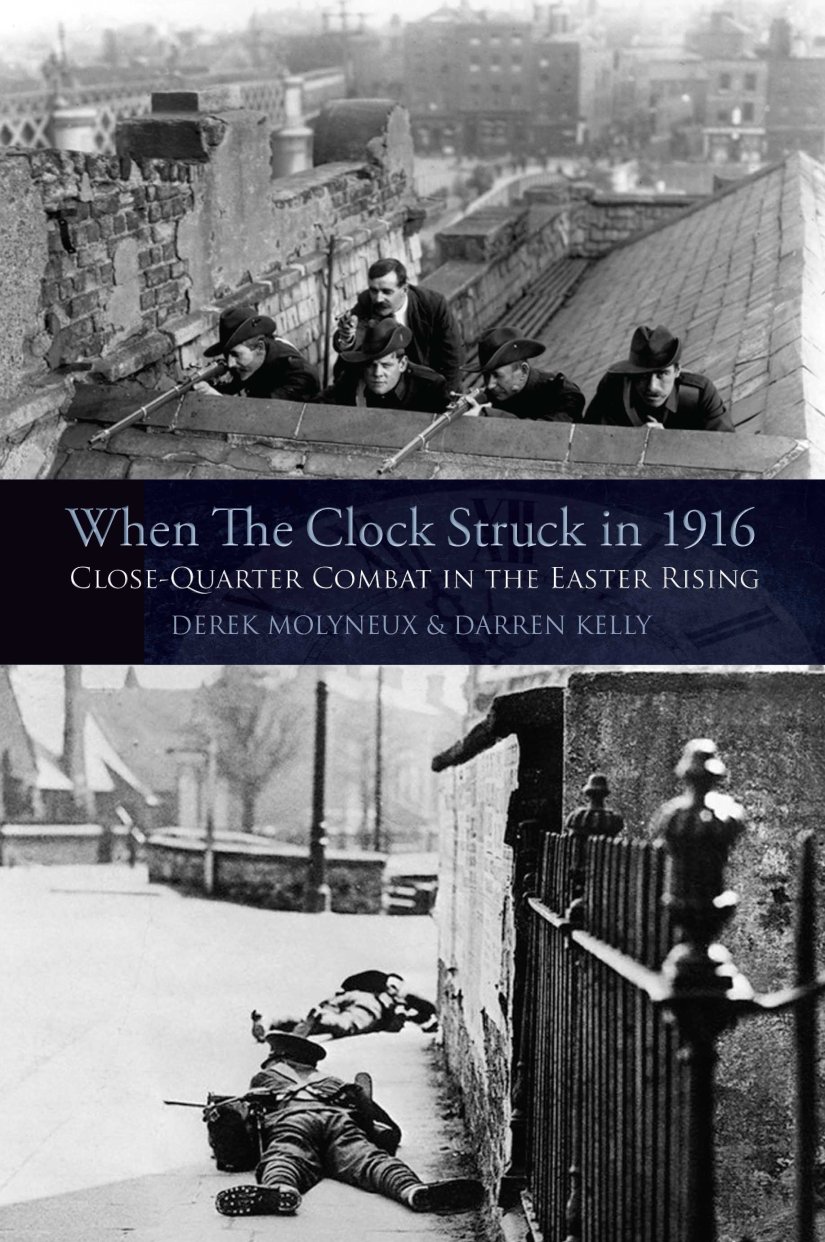
When The Clock Struck in 1916 book review and interview

When the Clock Struck.indd


Well I’ve helped to wind up the clock – I might as well hear it strike.’ Michael Joseph O’ Rahilly

The Irish Rebellion of Easter week 1916 is fleshed out in vibrant detail-the breadth of organization and planning and also the particulars of the fighting in this pivotal event in Irish history.

After the clock struck on 24th April 1916 the reader is brought shoulder to shoulder with the men and women who fought so bravely on the bullet raked streets of Dublin while they choked on the thick dust of collapsing buildings, deafened by whizzing bullets and screaming shells. Authors Derek Molyneux and Darren Kelly felt it was ‘only by placing the reader in the midst of the cauldron that was central Dublin during Easter Week 1916 that we feel we can do justice to the memories of those who found themselves there, whether by choice or otherwise’. They recounted how many of the British uniformed troops considered it ‘as dangerous a battlefield as any they had encountered before or afterwards. They relate how the Republican forces’ ‘skilful use of street-fighting tactics and their dogged tenacity in the face of overwhelming odds… was commended by British Prime Minister, Herbert Asquith.
13852AB9-96F8-4565-8F7D-6AAE66BC686F

The Irish Defence Forces, in their May edition of An Cosantóir Magazine wrote:

‘The authors have delved into the witness statements held by the military archives and have recreated the battles fought in Dublin’s streets. The book’s opening chapter details the attack on the Magazine Fort in the Phoenix Park. The detonation of the High Explosives store was to signal the beginning of the insurrection, but due to the fact that the Volunteers were unable to locate the keys for the room, the plan had to be shelved. A smaller explosion did manage to damage the magazine, but if they had succeeded, with the amount of explosives contained within; they might not only have blown up the store, but themselves with it.’

EXTRACT (edited)


Above image: The Magazine Fort and Paddy Daly

On Sunday morning 16th  April 1916, 27 year old Irish Volunteer Paddy Daly entered Clontarf Hall, and was greeted by Seán Mc Dermott . ‘Paddy has some great ideas about the Magazine Fort and I would like you to hear what he has to say’.  The Fort dated from 1734 and presented a daunting yet tantalising objective. It was a granite walled structure whose 12 foot high and 4 feet thick walls were protected by a deep ditch and ringed with several turrets.

Deception and guile were needed. Daly explained it was not uncommon for large groups of footballers to pass the Fort heading towards the nearby 15 acres playing fields. The assault force could simply disguise itself as such a group, using preferably Na Fianna members. Clarke nodded. Mc Dermott ordered, ‘Take the Fort. Blow it up, but no loss of life if possible’.
87B6C696-16CB-4DFE-B217-7A899DAF7170

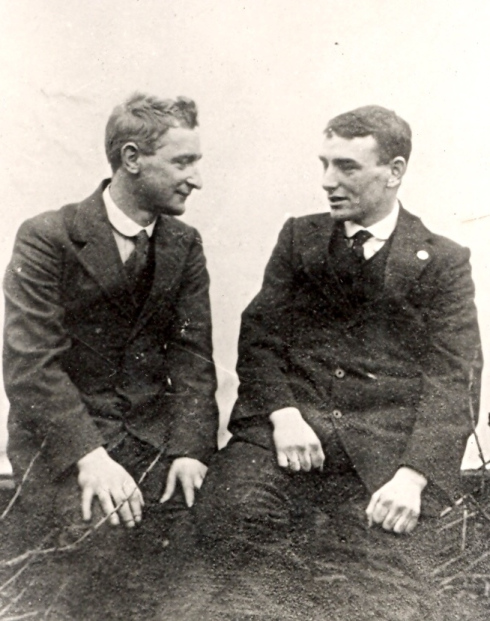
Above image: Eamonn Martin and Gary Holohan pictured.

On Easter Saturday, Garry Holohan found himself sitting in his bedroom staring at his haversack. His Martini-Henry rifle lay just across from it. With the rebellion just hours away, his nerves started to get to him, so to keep his mind occupied he checked his backpack over and over. He entered Pat’s room who laughed and said he was having the same trouble.

Holohan and Daly entered the Phoenix Park via its Islandbridge Gate. Daly threw the football into the centre of the group. Their kick about on the grass started and they began to edge towards the Fort. The sentry at the MagazineFort’s main gate cursed the monotony of the two-hour beat as he watched the bank-holiday footballers. Garry Holohan and Barney Mellows glanced up into the air, as the ball arched up and over the Fort’s wall. The game was on.
657107DF-169C-4EFC-B046-103E8771AC50

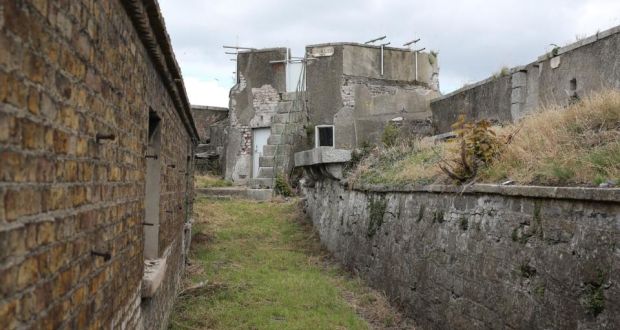
Above image: Interior of Magazine Fort.

They asked the sentry if they could have their ball back. As the sentry bent down to pick up the ball, he found himself dragged to the ground. He feared the worst momentarily as he felt the cold steel of a pistol barrel pressed into the nape of his neck, but the sharply uttered words, ‘don’t move and you’ll be fine’, provided welcome relief. The clatter of leather boots trampled close by him, the special force was in.

155F9D73-6D1A-4CEC-BDC8-C6D4EFF4973F

Above image: The Holohan brothers photographed in Na Fianna.

Holohan and Mellows rushed past, racing down the long corridor. The lack of gunfire to their rear reassured them that their backs were satisfactorily covered in order to allow them capture another sentry, who was positioned on the parapet of the large quadrangle at the Fort’s centre, before he could raise the alarm.

They burst through the door at the end of the corridor and into the bright sunlight, shielding their eyes as they scanned the parapet. ‘Where is he?’ muttered Holohan, then suddenly he spotted the tip of a bayonet sticking out by one of the machine-gun huts scattered along the structure. He rushed to the steps nearest him, while Mellows ran to the set furthest away, thereby surrounding the sentry, before they mounted the steps onto the parapet and shouted ‘Surrender!’ while Holohan covered the sentry with his pistol.

The sentry unshouldered his rifle to shoot, but his face suddenly twisted in pain as a shot rang out. Holohan had fired and hit him in the leg….

80F720C4-FE00-4E1D-8828-A04DBB9247A6

Above image: Irish Volunteers in the GPO photographed during the 1916 Easter Rising

This book covers, among others, the experiences of Volunteer Robert Holland, a sharpshooter who continued to fire despite the punishing recoil of his rifle. Volunteer Thomas Young and his group who were led to safety by his mother who acted as a forward scout – and then told her sons to lace up their boots. Mick Liston, who had a lucky escape when two bullets grazed the sides of his head simultaneously. Gerald Neilan who was with the Royal Dublin Fusiliers; his brother was a Volunteer. Thomas Devine who joined the fight after his work shift. Margaret Naylor, the mother of three who was shot dead on Mount Street Bridge. Within hours of her death, her husband was gassed to death in France where he was serving with a unit of the Dublin Fusiliers. The NCO who died when the grenade he threw at Clanwilliam House bounced off the second floor wall, flew back towards him and exploded next to his head. Twenty-year-old Sean McLoughlin who went from Volunteer to Captain to Commandant-General in five days: his cool head under a cataclysm of fire saved the lives of scores, if not hundreds, of his comrades in Moore Lane and Moore Street.
CE88EE73-E66B-46B4-8790-66F9C0F12CF1

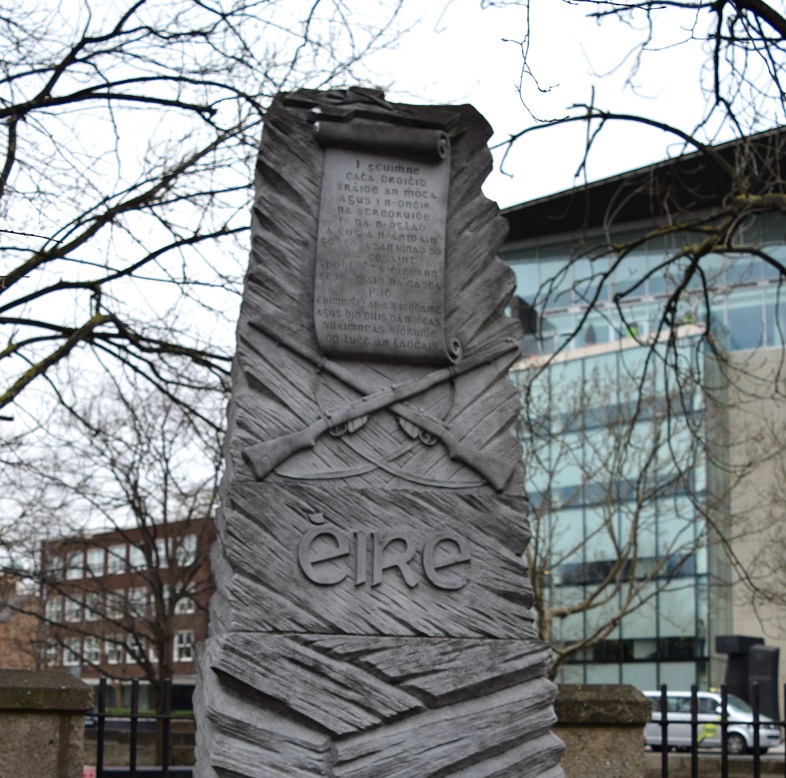
Above image: Monument to the 1916 battle at Mount Street Bridge, one of the bloodiest battles during the 1916 Easter Rising.

The reminders of the struggle are to be found today in just about every corner of Dublin’s city centre. From the numerous bullet holes throughout the buildings along Northumberland Road and O’ Connell Street, to the imposing façade of the Four Courts, there is much evidence of what the city endured, and what its people were faced with. It is also a reminder of what these people overcame.

Authors: Derek Molyneux and Darren Kelly are close friends who share a passionate interest in Irish and military history. Derek lives in Westmeath and Darren in Essex. They manage the popular Facebook page ‘Dublin 1916 Then and Now’. Derek has an intimate knowledge of Dublin’s streets, based on many years as a motorcycle courier, and understands how the same streets and people have preserved so much history.Darren, originally from Drumcondra in Dublin, had his initial interest in the 1916 Rising sparked at the age of ten and has since built up an in-depth understanding of Dublin’s revolutionary period.

You’re not going to get a better book on the close quarter combat of the 1916 Easter Rising in Dublin.

Review by Marcus Howard

Youtube Easter Rising Stories

Here is an interview I had with the authors Derek Molyneux and Darren Kelly.

And here is a film I made with them where they are taking you through the bloody battle of North King Street in 1916.



James Gough and the 1916 Battle of Portobello Bridge

Screen Shot 2018-12-11 at 22.18.37.png

Above photo: James Gough in later years.

Directed and edited by Marcus Howard, independent film maker. This is the story of James Gough who took part in the 1916 Easter Rising as told by his daughter Cora Montague and her husband John Montague.James Gough fought with the Irish Citizen Army and helped prevent British soldiers from nearby Portobello Barracks entering the city.

Davy's pub at Portobello bridge

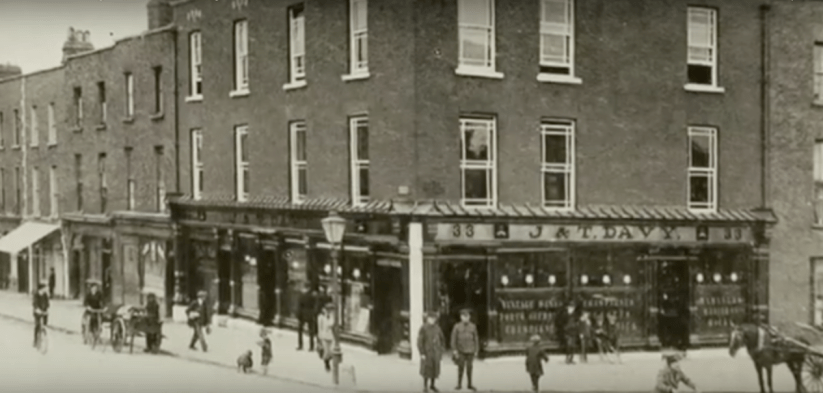
Above photo: Davy’s pub where James Gough and 5 others fought the Royal Irish Rifles during 1916

Portobello Bridge was an important vantage point that had to be secured during Easter week of 1916 to prevent British soldiers from barracks nearby entering the City. 1916 rebels reenforced their positions at Davy’s pub.

James Gough's wife.png

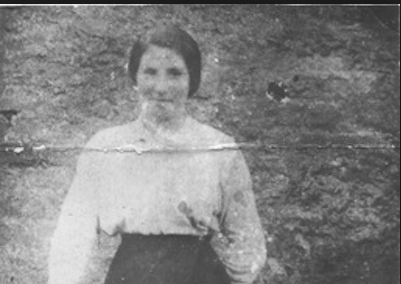
Above photo: Elizabeth Gough who was pregnant and expecting during Easter week.

The story of James Gough is a story of love that survived through war. Cora Montague, James Gough’s daughter tells you his 1916 story in the film below. James joined the Irish Citizen Army in 1914. He married in 1915. During Easter week he was told to assemble at Liberty Hall where he was under the service of Michael Mallin, one of the 16 who were later executed. James had got an all night pass to visit his wife in Baldoyle as his wife Elizabeth was expecting. Their only son Pearse would be born later in 1916.

On Easter Monday after the countermanding order by Eoin MacNeill, 6 of them left Liberty Hall in the morning to make their way to Portobello Bridge. He was to engage with the Royal Irish Rifles from Davy’s public house where they set up barricades and sniping positions. A large crowd had gathered to watch the fighting on Easter Monday. They had held up the British forces for nearly a day before retreating across the rooftops without one casualty. This allowed the Irish Citizen Army to fortify their positions around St Stephen’s Green in the centre of Dublin as well as in Sackville Street (now O’Connell Street),

Inside the College of Surgeons 1916

Above photo: Inside the College of Surgeons

They left the Green on Tuesday due to heavy British fire coming from the Shelbourne Hotel. They fought in the College of Surgeons and returned fire until Thursday. They surrendered after Pearse surrendered in Moore Street. James Gough was brought to Richmond Barracks and was then sent to Stafford Prison, to Frongoch and then to Wormwood Scrubs prison in England. He was released at the end of 1916 along with other Volunteers.

Medals belonging to James Gough.png

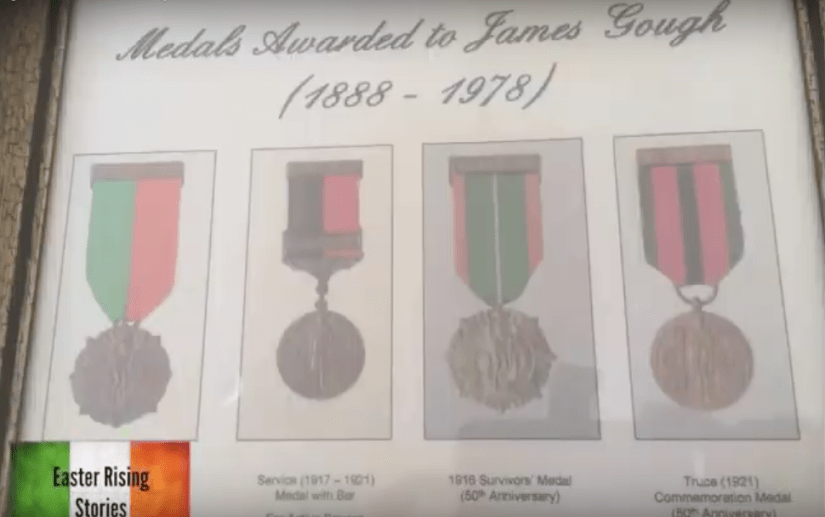
Above photo: Medals belonging to James Gough

James Gough joined the 2nd Battalion in 1918 where he remained until the Truce of 1921. He took neither side in the Irish Civil War but was arrested by the Free State and placed in Beggars Bush. He then rejoined his love Elizabeth where they both lived a long and happy life.

James and Elizabeth Gough in later years.png

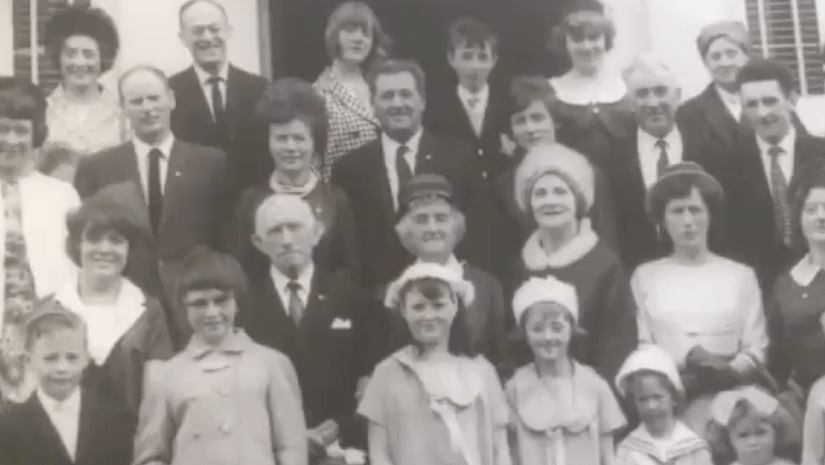
Above photo: James and Elizabeth Gough in later years

Screen Shot 2018-12-11 at 22.17.08

James Gough became a pacifist in his later life and knew the famous Rosie Hackett well.

Cora and John Montague also give their opinions on 2016 and how 1916 should be remembered. Have a look at the 10 minute video below for more about James Gough’s story and how love conquered all.


If you would like to see any other 1916 history films you can view them at our Youtube channel Easter Rising Stories

Facebook: Easter Rising Stories

The story of Molly O’Reilly, a revolutionary woman for Ireland

Molly O'Reilly

Directed and edited by Marcus Howard, independent film maker. Constance and Clare Cowley recount the story of their relative Molly O’Reilly, who hoisted the flag at Liberty Hall before the 1916 Easter Rising at the request of James Connolly. Molly was also involved in spying for Michael Collins after 1916 as well as being one of the first female hunger strikers in 1923. Constance and Clare also give their thoughts on how 2016, the 100th anniversary of the Rising, should be commemorated. At the Easter 2015 celebrations, Constance Cowley was present at the hoisting of the flag outside Liberty Hall organised by the Dublin North Inner City Folklore Project. The event was filmed by her daughter Clare and Marcus.


Countess Markievicz soup kitchen Liberty Hall

She was very influenced by conditions of poverty in Dublin. She assisted those involved in the 1913 Lock Out and assisted in the soup kitchen in Liberty Hall including Countess Markievicz (photo above).

She was deeply influenced by the writings of James Connolly and hid numerous weapons in her home after the Howth gun running in 1914. During Easter week she carried despatches around Dublin which was dangerous work.

After the Rising she went to the UK to study nursing, then returning to Dublin 3 years later for the War of Independence. As an employee of the United Services Club in St Stephens Green, Dublin, which was a club for British soldiers, she was able to provide Michael Collins, the IRA’s Director of Intelligence, with invaluable information  until the Truce.


Youtube Easter Rising Stories

Facebook: Easter Rising Stories

We Bled Together book review

We Bled Together

We Bled Together: Michael Collins, The Squad and the Dublin Brigade

By Dominic Price    Hardback €24.99

https://www.collinspress.ie/

This thrilling account of the daring espionage and killings carried out by both sides on Dublin’s streets during the War of independence is vividly brought to life by Dominic Price using eyewitness testimonies and war diaries. Price reveals their meticulous research into guerrilla tactics employed by the Cubans in their War of Independence, the 2nd Boer War and General von Lettow-Vorbeck against the British in east Africa. He shows Collins and the Dublin Brigade’s desperate methods; improvised explosive devices, chemical weapons.  Their sacrifice and determination to bring to birth Irish freedom is well recorded in this intimate and poignant book.

The Squad rare

Above photo: Members of The Squad

Extract:

‘The Squad never questioned Collins’ reasons for having someone killed. Mick Collins, as far as members of the squad were concerned, ‘was the kind of man it was easy to trust’ … The risks and danger experienced by his operatives affected Collins greatly and he could visualise their suffering. Eamon Broy, who spent a lot of time with the Director of Ira intelligence, related how Collins described events:

Collins had such a remarkable power of description that, listening to him, one could form a        vivid mental picture of the occurrences he described. For instance, in his account of the tortures of  Hales and Harte in West Cork [by the Essex Regiment and Major Percival], the impression he created was a vivid as if one actually saw the pliers being used to tear the flesh from the victim. These tortures were inflicted by the British Army long before the Black and Tans came to the country. As a result of his treatment Harte went insane.’

With the outbreak of the Civil War, many of the bonds that developed remained tight amongst the Dublin Brigade who were loyal to Collins. Price expertly looks at some of the darkest moments of the Civil War and the mental scars that left on those who were involved.

Book review by Marcus Howard

Dominic Price features prominently in a documentary by Marcus Howard on Michael Collins in 1918 which features below.

Youtube: Easter Rising Stories

Facebook: Easter Rising Stories


The Fight For Irish Freedom book review

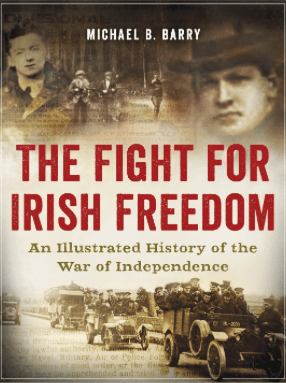
The Fight for Irish Freedom Michael Barry


The Fight for Irish Freedom: An Illustrated History of the War of Independence is a lavishly illustrated book which brings the War of Independence to life.

This volume completes the trilogy of acclaimed books by Michael B. Barry which tell the story of the Irish Revolution in illustrated form over the period from 1916 to 1923.

Barry was influenced by his father, Michael, who, as they drove around West Cork, would point out ‘a field where a man was shot dead by a passing group of Black and Tans’ or how Crown Forces forced the inhabitants of Ballydehob kneel down in the square and say a decade of the Rosary in a humiliating event which ‘further etched resentment in the local psyche’.

Michael B Barry

This writer brings the reader on a similar rich journey through the War of Independence accompanied by 650 images, engrossing photographs, detailed maps, illustrations from continental magazines and contemporary photographs. Nuanced captions enable the reader to better understand the War of Independence, its origins and the bloody struggle for freedom 191-1921.

Extract:

‘Just a lad of 18 summers’. Kevin Barry in a Belvedere rugby jersey.

Kevin Barry

Photo above: Kevin Barry

On 20 September, Volunteers of the 1st Battalion, Dublin Brigade. Intercepted a ration party (with an armed escort), as they headed to Monk’s Bakery, Upper Church Street. Instructed to raise their hands and surrender their weapons, the soldiers grabbed their rifles and there was an exchange of fire. The attackers escaped, leaving one British private dead and two other fatally wounded. Kevin Barry, a first-year UCD medical student, was found hiding under the British lorry, with a Parabellum in hand and was taken into custody. On 20 October, Barry was court-martialled at Marlborough (now McKee) Barracks. Found guilty of the murder of one of the soldiers, he was sentence to be hanged.

Women praying outside Mountjoy

Photo above: Women praying outside Mountjoy for Kevin Barry on day of his execution

The writer comments that the British wished to resolve the ‘Irish question’ – but on their own terms. ‘They were hampered by a constricted view of the world, seen through the prism of Empire’. Lloyd George wrote in 1920 ‘Ireland was a hell’s broth – Potas y Diafol’. Arrogance, condescension and racism characterised the British attitude to Ireland. Set out chronologically the riveting story of the war, the renaissance of Republicanism, the First Dáil and the new ruthlessness in the struggle for freedom and the increased tempo of the conflict up to the Truce in July1921 culminating in the Treaty of December 1921.

Barry guides the reader from the daring ambush at Solohead Beg to an intriguing account of the exceptional leader Michael Collins who saw the importance of intelligence and the need to maintain security by eliminating spies. They had sunk every previous Irish attempt at independence. The IRA developed a form of guerrilla war which proved particularly effective.

Ballyturnin House

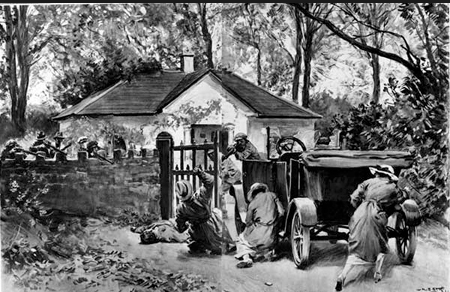
Photo above: Ambush at Ballyturnin House May 25th 1921

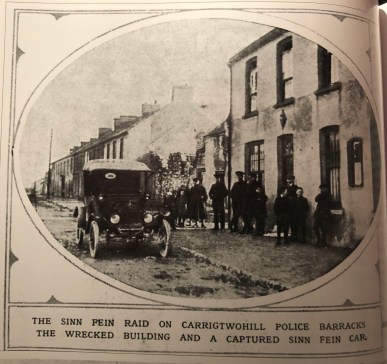
1919 moved into 1920, the RIC up to then the effective garrison for the British in Ireland, now came under severe assault. They were boycotted, RIC barracks were attacked. Morale plummeted, there were many resignations and recruitment came to a halt. Thousands of ex- service men were recruited in Britain and the Black and Tans arrived in Ireland.

Sinn Fein raid on Carrigtwohill police barracks

Photo above: Aftermath of raid on Carrigtwohill Police Barracks

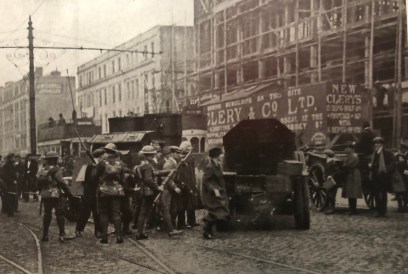
British troops jostle civillians on Sackville Street

Photo above: British troops jostling civilians on Sackville Street (now O’Connell Street)IMG_8464

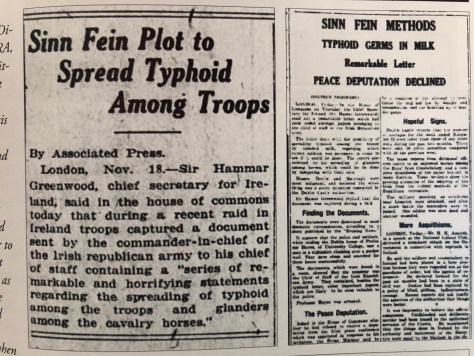
New information is given to the curious case of the alleged IRA Typhoid plot is revealed.

Author and historian Michael B. Barry was born in Ireland and studied engineering and economics at Trinity College, Dublin. He has written many books including the best-selling Victorian Dublin Revealed. In recent years he has written two critically acclaimed books on the Irish Revolution: The Green Divide, an Illustrated History of the Irish Civil War and Courage Boys, We are Winning, an Illustrated History of the 1916 Rising.

Available from amazon.com, dubraybooks.ie, omahony’s.ie 24.99 euros

You can buy it at this link too

Review by Marcus Howard

Youtube: Easter Rising Stories

Facebook: Easter Rising Stories