Blog

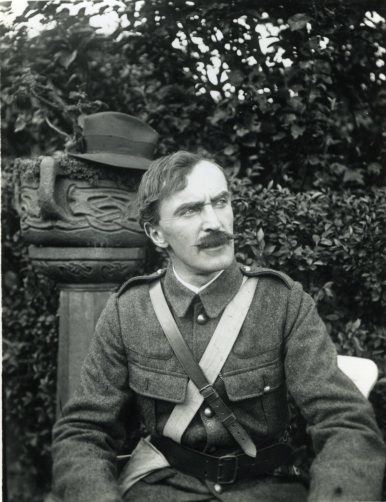
The story of John Blimey O’Connor and the London Irish in 1916

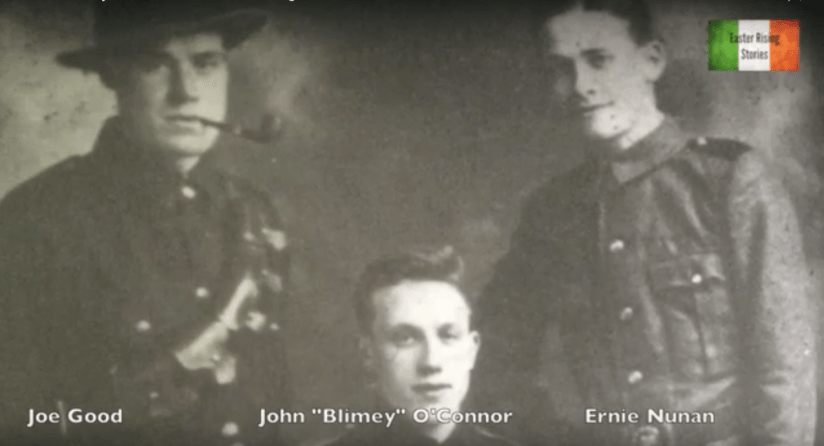
Directed and edited by Marcus Howard, independent film maker. John “Blimey” O’Connor was involved in telling the world through radio broadcasts about the 1916 Easter Rising as it actually took place. The story is told by his daughter Cáit Mhic Ionnraic who has 2 connections to the Rising, her father and father in-law. Her father travelled from London to serve in The Kimmage Garrison and played a very active role in 1916. Cáit also reads from his memoirs about his experiences in the GPO, getting the transmission out, and the last stand at Moore Street. His story weaves in and out among Joseph Plunkett, Tom Clarke, Michael Collins, The O’Rahilly, Sean Mac Dermott and many others. Cáit Mhic Ionnraic also gives her thoughts on the preservation of Moore Street.

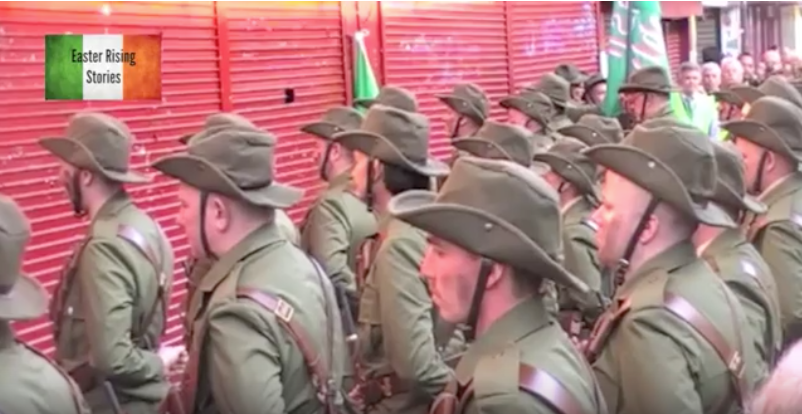
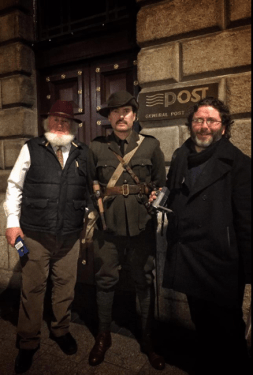
Reenactment of GPO garrison in Moore Street

Radio equipment from the school of wireless telegraphy was used to declare the Irish Republic to the rest of the world in case the Irish/British media would dismiss it as a disturbance.

The London Irish

What others have said about John “Blimey O’Connor:

“Blimey (Johnny) O’Connor was engaged on the job of climbing up the wireless mast to fix some wires and he was being sniped at all the time. How he had the pluck to carry on and how he was not riddled beats me.” Liam Tannam, GPO garrison.

Atlas of the Irish Revolution book review

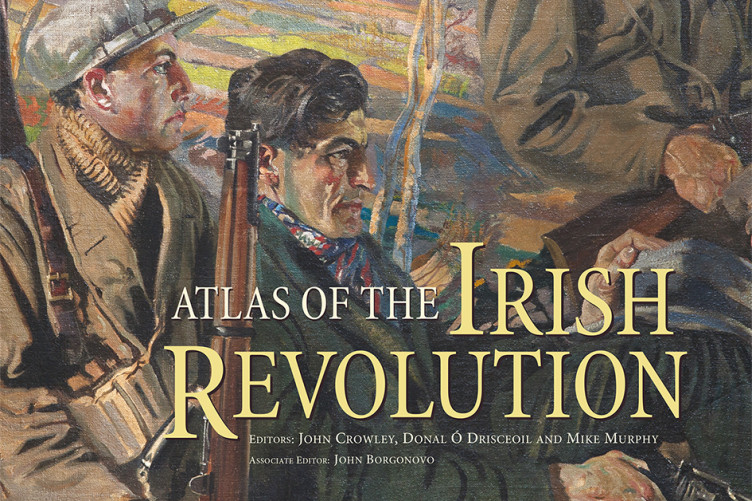
Atlas of the Irish Revolution cover

This landmark publication covers the Irish revolution 1913-23 in one thousand pages with contributions from over one hundred historians. Featuring over three hundred original maps it details how topology and location played such an important part in this complex conflict. This book places the Irish revolution in its international context with telling use of several hundred illustrations, and reproductions of rarely seen key documents. It analyses the political and social changes which shaped modern Ireland and details the unspectacular aspects of ordinary Irish life. It will have wide appeal to a specialist and popular readership.
‘Oh Grace just hold me in your arms and let this moment linger
They’ll take me out at dawn and I will die…’
The ballad or narrative song has played an influential role in both the shaping of popular memory and the humanising of key historical events. ‘Grace’ was jointly composed in 1985 by the brothers Frank and Seán O’Meara and popularised subsequently the singer Jim McCann. It tells the story of the marriage of the marriage of Joseph  Mary Plunkett and Grace Gifford in Kilmainham Gaol shortly before Plunkett’s execution. The tenderness and poignancy of that moment is captured in lyrics that have resonated with the public ever since. Joseph’s love for Grace is manifest in a letter (above) written in Moore Street on the ‘sixth day of the Irish Republic’ where he leaves all his possession to her. Their short and intense courtship would be brought to a dramatic end by the events of Easter Week. The centenary commemoration of the Rising showed a willingness by the public to engage with and understand the 1916 participants on their own terms.
Oscar Traynor
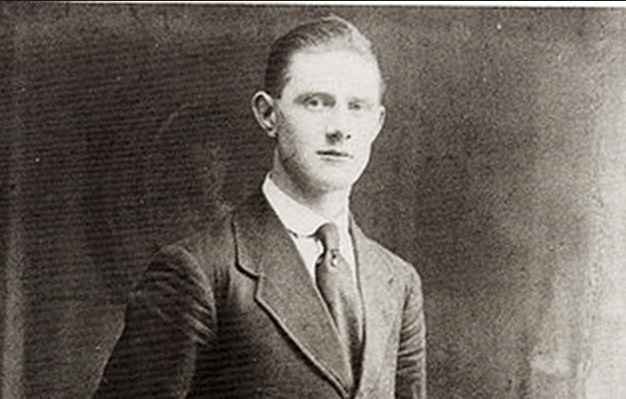
So how many active volunteers were there in Dublin during this period? Looking at the War of Independence, Oscar Traynor who took over the brigade on the deaths of McKee and Clancy, put the number at 1,250. The approximate strength of the various Battalions in early 1921 was 1st Battalion: 250; 2nd Battalion: 250; 3rd Battalion: 250; 4th Battalion: 300; 5th, or Engineers’, Battalion: 100. This was the active membership ‘or the strength that was given by the Battalions as being on parade each month’. The 5th Battalion looked after other specialist activities, such as engineering, logistics and first aid. The most common form of transport for arms was the lowly handcart, notwithstanding  folklore about pregnant women, prams and hearses. By the time of the Truce, every ASU included trained medical orderlies. Volunteers’ membership of the St. John’s Ambulance and the Dublin Fire Brigade provided useful logistical and intelligence resources, as did the large number of Volunteers working in Dublin Port and the railways. It was through this network that the Volunteers were able to ambush trains on which troops were travelling to and from the city.
Authors: John Crowley, Donal Ó Drisceoil and Mike Murphy John Borgonovo
Affiliation: University College Cork
Publication Year: Hardback September 2017
Pages: 984
Size: 299 x 237mm

ISBN: 9781782051176

Price 59 euros
Book review by Marcus Howard
Facebook: Easter Rising stories

The O’Rahilly Easter Rising Stories film

Directed and edited by Marcus Howard, independent film maker. Proinsias O’Rathaille is the grandson of The O’Rahilly who was shot in Moore Street during the 1916 Easter Rising. He was an Irish Republican, nationalist and founding member of the Irish Volunteers when they were set up in 1913. Initially he opposed the Rising but ended up joining the fight before leading the famous charge down Moore Street from the GPO.


The O'Rahilly

He is also known for saying the following famous quotes: “Well, I’ve helped to wind up the clock — I might as well hear it strike!” Another famous saying of his was “It is madness, but it is glorious madness.”

This film takes you on a tour of Moore Street as his grandson follows his steps as well as recalling his early life, romance with Nancy O’Rahilly and treatment as he lay dying. Nancy O’Rahilly was a co-founder of Cumann na mBan.

Proinsias mentions in the film that his two grandparents names are now on plaques in Wynn’s Hotel, Dublin.

Proinsias O'Rathaille, Dave Swift and Marcus Howard

Youtube channel:

Visit Easter Rising Stories Youtube channel for over 150 exclusive videos, documentaries and speeches.

Facebook: Easter Rising Stories


May 25 The Burning of the Custom House by Liz Gillis book review

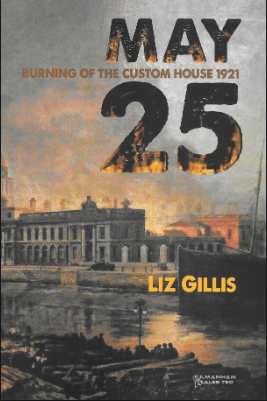
May 25 The Burning of the Custom House by Liz Gillis

The bold attack on Dublin’s Custom House on May 25th 1921 has been the subject of much heated debate. Liz Gillis, historian and author of Ireland’s early 20th century revolutionary period brings the dramatic to life. This watershed moment in the War of Independence is told as part of the Kilmainham Tales Special series edited by historian Mícheál Ó Doibilín. Beautifully designed by Mícheál using many contemporary photographs, the planning and the event’s consequences are explored.

The event itself is told at a cracking pace, using the participants’ own words, immersing the reader in the drama.

Vinny Byrne

EXTRACT:
Vinny Byrne was on the upper floor when the fighting started outside. He ran down to the main hall and found a chaotic scene with people running trying to get out of the building:

I ran along the corridor towards the docks and, as I came to the end, I could see the Auxies on the quay, firing. I retreated back to the hall. There was not a soul to be seen. I made up my mind to clash out when an Auxie appeared at the door. I opened up and he ducked back….

The book arose when Mícheál and Liz were working as tour guides in Kilmainham Gaol when they discovered a photo album belonging to the Volunteer Cyril Daly. It contained many photographs of young IRA prisoners who had been involved in the burning of the Custom House. They discovered that 270 men were involved, making it the largest IRA operation since the Easter Rising.

Liz Gillis

‘We must listen to their words, and we can agree or disagree with these testimonials, but it would be to our detriment if we ignore them.’

Did this event contribute to the eventual truce between Britain and Ireland in July 1921? Read and see.

The book can be purchased at the following link. http://kilmainhamtales.ie/may-25—burning-of-the-custom-house-1921.php

Liz Gillis has featured in a number of documentaries on the Youtube channel Easter Rising Stories.
Her work on The Hales Brothers is a real milestone as well. Here is an interview I had with her about her other book The Hales Brothers and The Irish Revolution
Review by Marcus Howard
Marcus Howard and Liz Gillis


The GAA and the War of Independence by Tim Pat Coogan book review

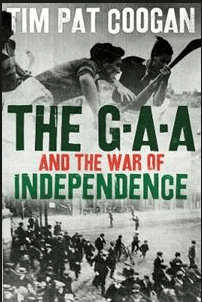
GAA and War of Independence book cover

Available amazon.com, harpercollins.com, easons.com         23.99 euros

Tim Pat Coogan, in his new book, The GAA and the War of Independence, succeeds in creating the ‘intimate’ connection between the GAA and Irish Freedom. An anecdotal, conversational tone guides the reader from the founding of the association through the role of the Irish Republican Brotherhood, the effects of the revolutionary period (1912-23), the Northern Troubles and the GAA’s effort to tell Irish history by naming stadia after those who gave us our Irish freedom.

Tim Pat Coogan

On the first of November 1884, in the billiard room of the Hayes Hotel in Thurles, Co. Tipperary, the founding members, about seven and almost all Fenians, saw this organisation as promoting Irish identity, reviving traditional games and facilitating Irish sentiment. Mayo athlete Patrick Nally and Clare teacher Michael Cusack were walking in Phoenix Park and saw no-one playing games, a symbol of the inertia of the time. Archbishop Croke related how the worst thing he had to endure was the sight of young men sitting around ditches with humps on them and no work to do. Due to the colonial system everything was English. Students were taught to be happy English children. English games were supported by the landlords. Suddenly the infant GAA ‘spread like the prairie fire’. Coogan details how British authorities in Dublin Castle were aware of the organization’s potential as a revolutionary seedbed and they treated the GAA from the outset as a semi-subversive movement.

Michael Collins and Harry Boland

An interesting anecdote is told of the author’s meeting in 1883 with one of South Korea’s senior advisers who displayed a ‘remarkable knowledge of Irish culture and history’. He told Pat that before the Japanese annexation of the Korean peninsula in 1910, they sent four professors to research the best method for colonizing a people. They were impressed by Britain’s record in Ireland, its systematic removal ‘of native culture, language, pastimes and dress’. The British had ‘incubated in Ireland feelings of inferiority’. ‘The initial growth of GAA clubs in the United States, for example, was fuelled by mass emigration that accompanied the trauma of the Great Famine in Ireland and its poverty stricken aftermath.’

But while the Anglo- Irish Duke of Wellington claimed the battle of Waterloo was won on the playing fields of Eton, Coogan puts forward a convincing case that Ireland’s War of Independence ‘in the early part of the twentieth century was won on the playing fields of the GAA’. ‘They thought if they got the men together and trained them in hurling, it would be a sort of martial art’. So the Irish Volunteers drilled with hurley sticks. Indeed Pearse’s famous oration at the graveside of O’Donovan Rossa in Glasnevin Cemetery was spoken surrounded by GAA members holding hurley sticks instead of rifles.

Coogan proclaims the GAA to be a multi-faceted organization, fostering a benign consciousness of being Irish which makes the movement a serious contender for the title ‘Most Valuable Institution in the Country’. Its reach is global. In 2017 a successful Asia Games was staged in Singapore. It has fostered the ideal of voluntarism and has contributed a distinctive sense of national identity that would be hard to replicate anywhere in the world.
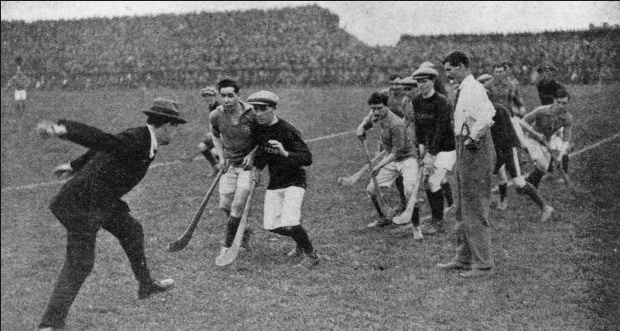
Michael Collins in Croke Park throwing a sliotar at a hurling match in 1921

The GAA is a broad organization. Thomas McCarthy, a founding member, played rugby for Ireland and worked as a District Inspector in the RIC. The Thomas McCarthy Cup, part of the peace process in Northern Ireland, is awarded for the annual competition held between the Republic’s An Garda Síochána and the Police Service of Northern Ireland (PSNI). This evolving GAA was confident in its own identity to assist the Irish Rugby Football Union (IRFU) by leasing the Croke Park for Six Nations and other games. Peter McKenna accompanied Coogan, together with a set of architectural plans, into an investigation into the rumour that Girvan Dempsey’s try was on the spot where the Tipp player Michael Hogan was murdered on the afternoon of ‘Bloody Sunday – 21st November 1920. Earlier that day Michael Collins’s hit squad had struck a ‘body blow in a series of raids against a British military undercover death squad that had been making steady inroads into Collins’s Irish intelligence network’. It mattered that The GAA had decided to welcome rugby to Croke Park.

This fascinating book showcases the proud history of the GAA and its efforts to nurture the best of Irish identity. It is a must read for every GAA fan and enthusiast, at home and abroad.

Reviewed by Marcus Howard

Youtube: Easter Rising Stories

Facebook: Easter Rising Stories

Tim Pat Coogan and Marcus Howard