ON THIS DAY
12 October
1798. Wolfe Tone’s last battle

Theobald Wolfe Tone. On 12 October 1798 he was a French officer aboard the Hoche, not yet a prisoner identified by name.
On 12 October 1798, off Donegal, Theobald Wolfe Tone fought his last battle. The risings of the summer were already beaten, and Humbert’s landing at Killala had ended at Ballinamuck. A further French expedition, under Admiral Bompart, was still at sea. Tone was aboard the 74-gun Hoche, with the rank of chef de brigade. Sir John Borlase Warren’s squadron found them off Tory Island. The fight lasted about six hours. The Hoche was shattered and struck her colours. Tone was not arrested that day as Wolfe Tone. He was held with the other French prisoners. He was brought ashore at Buncrana on 31 October and recognised there by Sir George Hill, who had known him at Trinity.

The action off Tory Island, engraved in 1799. The Hoche is the French flagship on the left of the view.
He was taken to Dublin in irons. On 10 November he faced a court martial in his French uniform and asked to be shot as a soldier, not hanged. The court refused. Lawyers challenged the trial because the civil courts were open, and Lord Kilwarden granted a writ. Before it could stop the sentence, Tone suffered a severe wound to his throat in prison. He died on 19 November. Two years earlier he had sailed with the great fleet that reached Bantry and could not land. This expedition was the last of those attempts. It ended under the guns of the Royal Navy.
1920. Five Volunteers killed at Saltmills
On the night of 12 October 1920, at St Kearns near Saltmills in County Wexford, five IRA Volunteers were killed by their own explosives. Fourteen men of the South Wexford Brigade were in an old house making bombs, meant for an attack on the barracks at Foulkesmill. Candles and cart lamps lit the room. Sacks covered the windows. Martin Roche, Robert Walter Walsh and Michael Fitzgerald were killed at once. James Gleeson lived about half an hour. James Byrne died the next morning in Saltmills. Nine others were injured. The roof was thrown to the far side of a field.
How it started is not agreed. Michael Conway, who was there, said Tom Gleeson struck a detonator with a penknife, a spark showed, and a blue flame filled the room. John Timmins, the officer in charge, said fumes from the explosive met the candle flames. No soldier fired. The five were still casualties of the war.
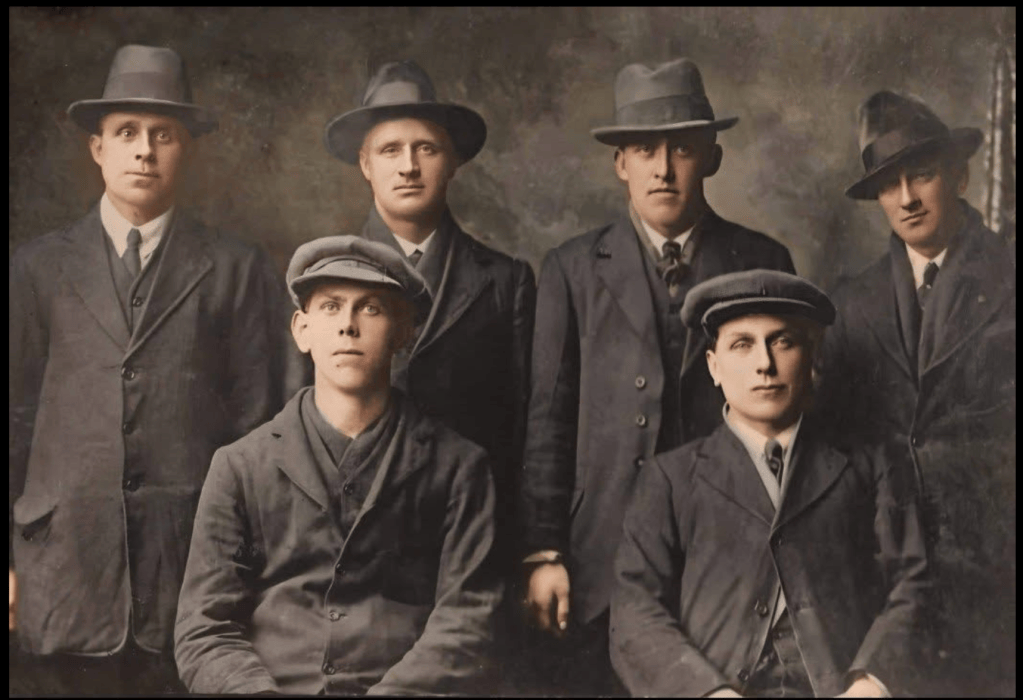
Six survivors of the Saltmills disaster pictured in February 1922 on their release from Dartmoor prison. Backrow:Thomas Gleeson, John Timmins, Michael Conway, Edward Kelly. Front Row: Patrick Kinsella, Stephen Barron.
References:
Dictionary of Irish Biography (2009) ‘Tone, Theobald Wolfe’. Royal Irish Academy. DIB — Theobald Wolfe Tone
Dictionary of Irish Biography (2009) ‘Hill, Sir George Fitzgerald’. Royal Irish Academy. DIB — Sir George Fitzgerald Hill
McGarry, S. (2016) ‘“Close enough to toss a ship’s biscuit ashore”—the French fleet at Bantry Bay, 1796’, History Ireland. History Ireland — French fleet at Bantry Bay
Wexford County Council (2021) Timeline of the War of Independence in Wexford. Wexford County Council historical booklet


Leave a comment