ON THIS DAY
5 October
1922. The last killing in Belfast’s two years of violence
On the morning of 5 October 1922, Mary Sherlock went out to buy food for her family’s dinner. She had just left a butcher’s shop on the Newtownards Road, in a Protestant part of east Belfast, when a gunman walked up behind her and shot her in the head. She was a Catholic. There was no announcement that the killing in the city had ended. Hers was the last death in the violence that had run since July 1920.
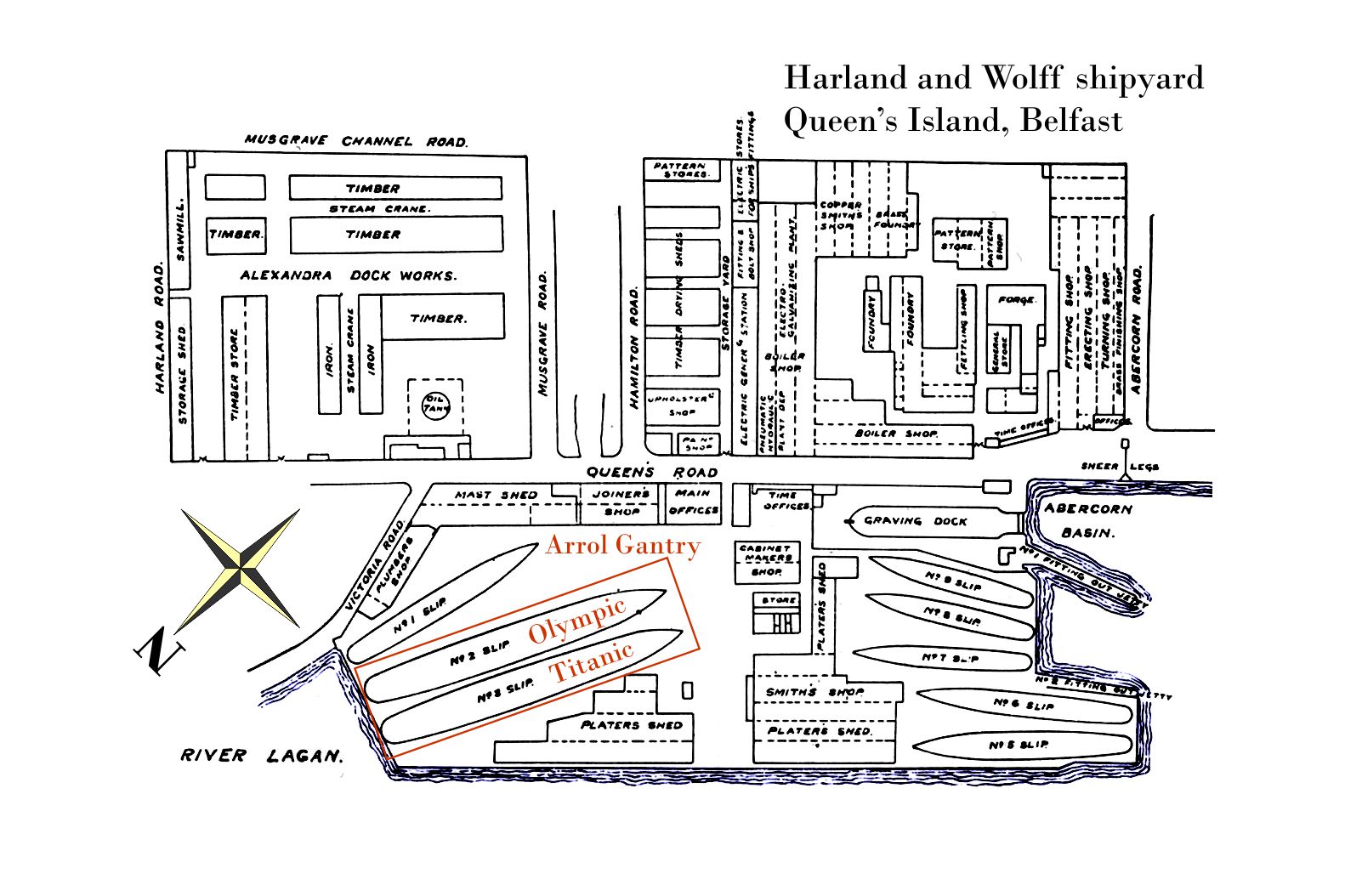
Harland and Wolff, Queen’s Island, in 1911. The expulsions of Catholic workers and Protestant labour activists began in the shipyards on 21 July 1920.
What followed was more than two years of shooting, bombing, arson and reprisal, involving civilians, the IRA, loyalist gunmen, the police and the Special Constabulary. Catholics were about a quarter of the city and a far higher share of the dead. In March 1922 six members of the McMahon family were killed in their home. Days later Catholic civilians were killed in their houses on Arnon Street. In May, at a cooperage in Little Patrick Street, gunmen separated the workers by religion, let the Catholic go, and shot four Protestants, three of them fatally. The published counts of the dead run from 498 to 501. A revised list stands at 500. Most of those killed were civilians. About 10,000 people were driven out of their work, and about 23,000 were made homeless.
Nationalists called it a pogrom. Some historians still use that word. Others, including Alan Parkinson and Robert Lynch, argue that it does not fit a conflict in which more than one side killed. By the autumn the IRA’s northern offensive had failed, and internment and the Special Powers Act had suppressed republican activity in the city. The killing did not end with a peace. It ended, on this count, with Mary Sherlock. A later revision added three deaths that occurred after 5 October and belong to the toll, but she remains the last person killed during the violence itself.
References:
CAIN (Conflict Archive on the Internet), Ulster University (n.d.) ‘Chronology of Key Events 1800 to 1967’. Available at: https://cain.ulster.ac.uk/othelem/chron/ch1800-1967.htm (Accessed: 27 September 2026).
Coleman, M. (2020) ‘Belfast on the brink in 1920’, The Irish Times, 9 March. Available at: https://www.irishtimes.com/culture/belfast-on-the-brink-in-1920-1.4194215 (Accessed: 27 September 2026).
Dobrianska, N. (2021) Digital Sources on the Inter-Communal Violence in Belfast in 1920–1922: Finding Aid. Working Papers in Irish Studies. Belfast: Queen’s University Belfast. Available at: https://www.qub.ac.uk/schools/media/Media1053252smxx.pdf (Accessed: 27 September 2026).
Glennon, K. (2020) ‘The Dead of the Belfast Pogrom – Counting the Cost of the Revolutionary Period, 1920–22’, The Irish Story, 27 October. Available at: https://www.theirishstory.com/2020/10/27/the-dead-of-the-belfast-pogrom-counting-the-cost-of-the-revolutionary-period-1920-22/ (Accessed: 27 September 2026).
Glennon, K. (2022) ‘Violence against women in Belfast, 1920–22 – part 1: Killing and lethal violence’, The Irish Story, 5 July. Available at: https://www.theirishstory.com/2022/07/05/violence-against-women-in-belfast-1920-22-part-1-killing-and-lethal-violence/ (Accessed: 27 September 2026).
Lynch, R. (2006) The Northern IRA and the Early Years of Partition, 1920–1922. Dublin: Irish Academic Press.
Parkinson, A.F. (2004) Belfast’s Unholy War: The Troubles of the 1920s. Dublin: Four Courts Press.
Queen’s University Belfast (2022) The Belfast ‘Pogroms’: The McMahon Murders, 24 March 1922. Available at: https://pureadmin.qub.ac.uk/ws/portalfiles/portal/371688186/A_Level_1922_Resources.pdf (Accessed: 27 September 2026).


Leave a comment