ON THIS DAY
8 October
1921. The journey to London

Arthur Griffith led the party that left Dublin on 8 October.
At 8.25 on the morning of Saturday 8 October 1921, a special carriage left Westland Row. In it were Arthur Griffith, Robert Barton, Éamonn Duggan and George Gavan Duffy, with their staff. Crowds cheered the train. People along the line to Dún Laoghaire, still officially Kingstown, waved tricolours. At Carlisle Pier they boarded the steamer Curraghmore for Holyhead. Michael Collins was not with them. He crossed the next day. Éamon de Valera, President of the Dáil, was not going at all.
The day before, the Cabinet had instructed them to negotiate and to conclude a treaty, and also to send the final text to Dublin before it was signed. That contradiction mattered later. Britain would not recognise a republic. The Dáil had claimed one. Northern Ireland already had its own parliament. Defence, trade and the ports were still open. The talks were to begin at Downing Street on 11 October. None of the five could know that the document signed on 6 December would split the movement and lead to civil war. On this morning there was only the train, the pier and the steamer.
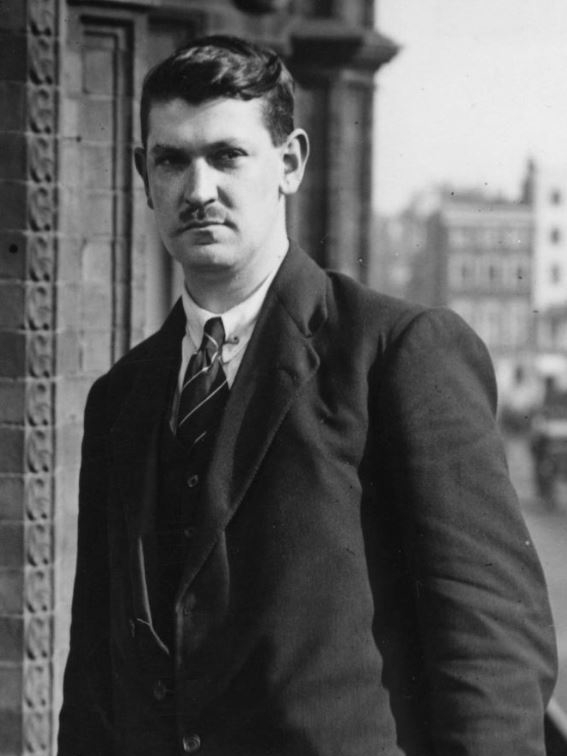
Michael Collins in 1921. He stayed in Ireland on 8 October and travelled the next day.
Collins had not wanted the job. A soldier was being sent to negotiate, and a man who had lived underground was about to arrive in London in the open. A local tradition dates his engagement to Kitty Kiernan to this day, at the Grand Hotel in Greystones. A letter he wrote before leaving speaks of making their understanding more binding. The relationship was real. The exact hour and place of a proposal are less certain. He wrote to her often from London. The marriage never happened. He was killed the following August.
1917. The papers are still full of Thomas Ashe
On 8 October 1917 the Irish papers were still taken up with Thomas Ashe, who had died on 25 September after forcible feeding, and whose funeral on 30 September had filled Dublin. The Westmeath Independent wrote that his death was hastening the end of Redmondism. Even the Irish Times, no friend of Sinn Féin, saw that the funeral had given the movement a new force. Four years later, men from that movement were on the boat to negotiate with the British prime minister.
References:
Ferriter, D. (2015) A Nation and Not a Rabble: The Irish Revolution 1913–23. London: Profile Books.
Martin, D. (2016) Michael Collins and Granard. Granard: Granard Motte Community Enterprise. Available at: https://granardmotte.ie/wp-content/uploads/2016/10/Michael-Collins-Granard-2.pdf (Accessed: 27 September 2026).
Pakenham, F. (1935) Peace by Ordeal: An Account, from First-Hand Sources, of the Negotiation and Signature of the Anglo-Irish Treaty 1921. London: Jonathan Cape.
Raughter, R. (n.d.) ‘Greystones during the Revolutionary Period: As revealed by the Bureau of Military History Witness Statements’, Wicklow Heritage. Available at: https://heritage.wicklowheritage.org/topics/wicklow_1916-_1923/wicklow-the-war-of-independence/greystones-rosemary-raughter/greystones-during-the-revolustionary-period-as-revealed-by-the-bureau-of-military-history-witness-statements-by-rosemary-raughter/ (Accessed: 27 September 2026).
RTÉ/Century Ireland (2017) ‘Death of Thomas Ashe dominates Irish newspapers’, 8 October. Available at: https://www.rte.ie/centuryireland/articles/death-of-thomas-ashe-dominates-irish-newspapers (Accessed: 27 September 2026).


Leave a comment