ON THIS DAY
2 October
1917. A U-boat strikes off Rathlin Island
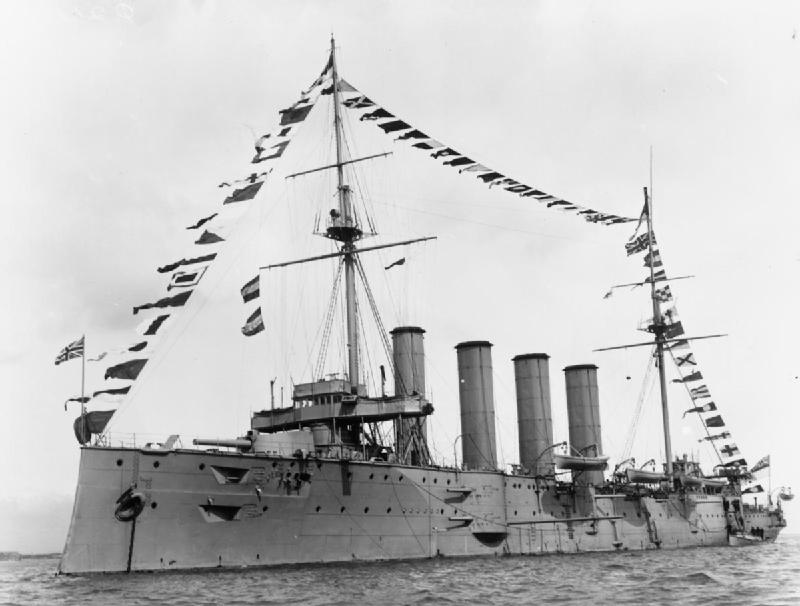
HMS Drake before the war. Eighteen of her crew were killed on 2 October 1917.
On the morning of 2 October 1917, off Rathlin Island, the war came within sight of the Antrim coast. HMS Drake had been escorting convoy HH24 across the Atlantic. The convoy dispersed at about eight o’clock. A little after nine, U-79, commanded by Kapitänleutnant Otto Rohrbeck, torpedoed Drake on the starboard side by the No. 2 boiler room. The room flooded at once. Eighteen men were killed. Captain Radcliffe hoped at first to reach Belfast and the Harland and Wolff yard. The ship was taking water too quickly, and her steam steering was gone, so he made for Church Bay on Rathlin.
At 10.37 Drake, barely under control, collided with the cargo ship Mendip Range. She anchored in Church Bay before noon. The crew were taken off, and at 2.35 that afternoon she capsized. The same morning the destroyer Brisk was lost nearby, most likely on one of the mines U-79 had laid a few days earlier, and 31 of Brisk’s crew were killed. While Dublin was still absorbed by the death of Thomas Ashe, a war for the Atlantic sea lanes was being fought a few miles off the Irish coast. The wreck remains in Church Bay. In 2017 it became the first shipwreck in Northern Ireland to be protected as a historic monument.
1920. The reprisals argument reaches the newspapers

General Sir Nevil Macready, who commanded British forces in Ireland.
London dispatches on 2nd October 1920 described the discussion with Sir Hamar Greenwood and General Sir Nevil Macready. The subject was reprisals by Crown forces. Macready told ministers that the allegations had been exaggerated, and that some of the violence had followed immediately on the killing or wounding of policemen rather than on an order from the government.

Cork after the burning of December 1920.
The British government was already worried that indiscipline was damaging its position in Ireland. It had not stopped the burnings. Before the year was out, the burning of Cork would make reprisals impossible to separate from the political argument over British rule.
References:
Wessex Archaeology (2006) HMS Drake, Church Bay, Rathlin Island: Undesignated Site Assessment, Ref. 53111.02r-2. The archaeological investigation drew upon Captain Radcliffe’s contemporary report and Admiralty material relating to the loss of the cruiser. Available at: Wessex Archaeology — HMS Drake site assessment (Accessed: 27 September 2026).
Rathlin Development and Community Association (n.d.) ‘HMS Drake’, Rathlin 360. The local history records Drake being torpedoed approximately five miles north of Rathlin, her damaged journey to Church Bay, collision with Mendip Range and subsequent sinking. Available at: Rathlin 360 — HMS Drake (Accessed: 27 September 2026).
Department for Communities (Northern Ireland) (n.d.) ‘Historic wrecks’. The Department confirms that HMS Drake was scheduled for protection in 2017 and was the first historic shipwreck in Northern Ireland protected through this mechanism. Available at: Department for Communities — Historic wrecks (Accessed: 27 September 2026).
RTÉ/Century Ireland (2020) ‘British cabinet told that reprisal allegations in Ireland are exaggerated’, Century Ireland, account datelined London, 2 October 1920.
RTÉ/Century Ireland (2020), ‘British cabinet told that reprisal allegations in Ireland are exaggerated’. Available at: Century Ireland — British Cabinet and reprisals (Accessed: 27 September 2026).


Leave a comment