ON THIS DAY
7 October
1922. Three teenagers found dead at Clondalkin
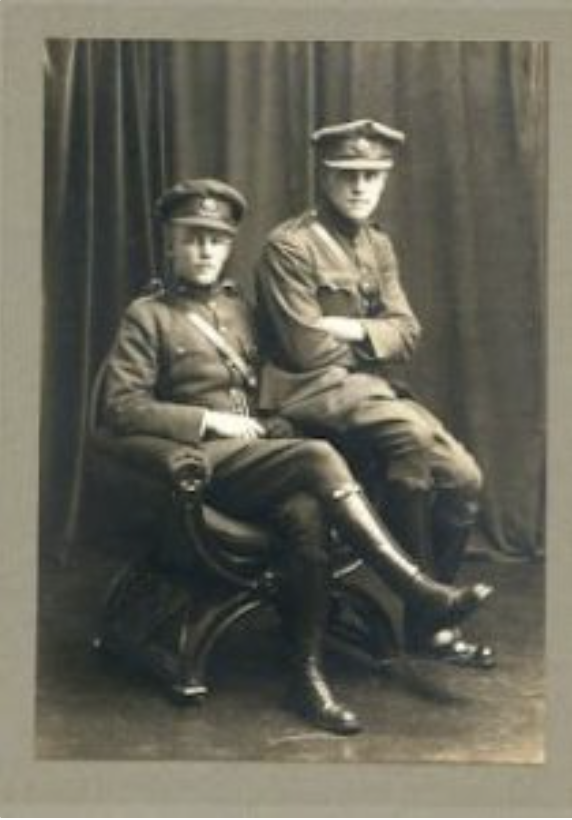
Emmet Daltonand his younger brother Charlie. Charlie was one of the three officers seen with the boys. His guilt was not proved. Emmet was not there.
Early on 7 October 1922 a dairyman found two bodies on Monastery Road, near Clondalkin. A third was on quarry land nearby. They were Eamonn Hughes, Brendan Holohan and Joseph Rogers, sixteen and seventeen. Their families described them as studious, religious and hardworking apprentices. Hughes and Holohan had been shot several times, and shot again after they fell. A doctor counted sixteen wounds on Rogers. The evening before, they had gone out to paste anti-Treaty handbills. They were seen on Clonliffe Road getting into a car with three National Army officers: Charles Dalton, Nicholas Tobin and Seán O’Connell. Dalton had been in the movement since he was fourteen, and had worked in Michael Collins’s intelligence. What happened after the car has never been established.
Later accounts have treated Dalton’s guilt as fact. Anne Dolan’s point is that suspicion is not proof. The papers put the three boys in that car. They do not show who fired. These were not deaths in a battle, and they were not the executions that began at Kilmainham on 17 November, when James Fisher, aged eighteen, Richard Twohig and John Gaffney, both nineteen, and Peter Cassidy, aged twenty-one, were shot for possession of weapons. The Clondalkin deaths belong with the abductions and unofficial killings of the war.
In 1933 Hughes’s brother applied for an allowance for their parents. Mark Hughes, a clerk, could no longer work. Annie Hughes, a music teacher, could no longer teach. The Pension Board was asked not to send letters to the house, because mention of their son’s name would do no good. Dalton later suffered a serious psychiatric illness, and his pension file records that the revolutionary years still troubled him. That proves his own distress. It does not prove that he killed them. A century on, the three
1919. Dublin’s unarmed police are issued pistols
On 7 October 1919 the news was of compensation. Detective Patrick Redmond of the Dublin Metropolitan Police was awarded £50. He had chased a pickpocket on Marlborough Street. A crowd, believing the man was a Sinn Féiner, knocked him down and kicked him. On Gardiner Street he and another officer were stoned. He was two months on sick leave. At Tralee, Sergeant Oats was awarded £250 and Constable O’Connell £50 for an attack at Ballinascarthy, in County Cork, on 24 June. Masked men knocked them from their bicycles, took a rifle and ammunition, and fired at the sergeant. The bullet struck his brace buckle.
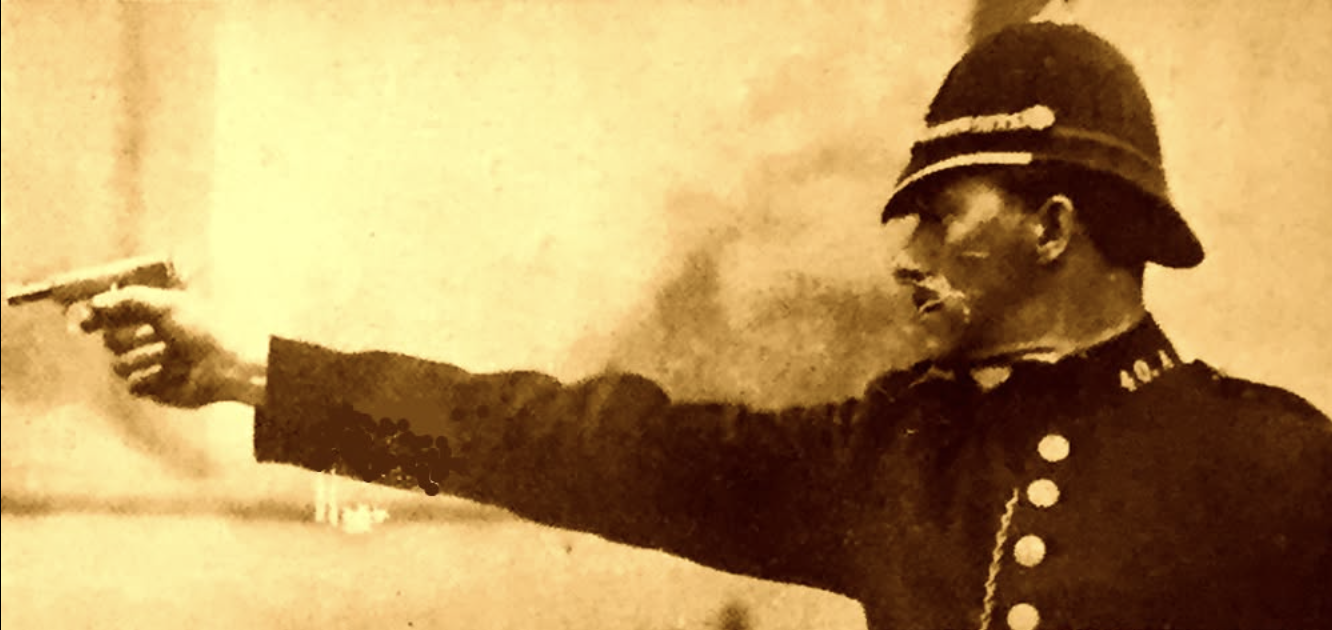
A Dublin Metropolitan policeman with a pistol, October 1919. The uniformed force had not carried firearms before.
Unlike the Royal Irish Constabulary, the uniformed DMP had policed Dublin without firearms. That week it was reported that they were being issued pistols, and Irish Life published a photograph of men being shown how to handle them. The whole force was not armed on this one day. By December the DMP was asking for volunteers because the city was thought insufficiently guarded at night. On 7 October 1919 an attack on a policeman was still a matter for compensation. Three years later, on the same date, three boys were found shot outside Clondalkin, and nobody has been proved to have killed them.
References:
Bielenberg, A. and Dorney, J. (2024) The Irish Civil War Fatalities Project. RTÉ History. Available at:
https://www.rte.ie/history/civil-war-fatalities/
(Accessed: 27 September 2026).
Dolan, A. (2022) ‘7 October 1922: The Killing of Teenagers Eamonn Hughes, Brendan Holohan and Joseph Rogers’, Century Ireland. Available at:
https://www.rte.ie/centuryireland/articles/7-october-1922-the-killing-of-teenagers-eamonn-hughes-brendan-holohan-and-j
(Accessed: 27 September 2026).
Hopkinson, M. (2002) The Irish War of Independence. Dublin: Gill & Macmillan.
Townshend, C. (1975) The British Campaign in Ireland, 1919–1921: The Development of Political and Military Policies. Oxford: Oxford University Press.
RTÉ/Century Ireland (1919) ‘Police awarded compensation due to recent political disturbances’, Century Ireland, 7 October. Available at:
https://www.rte.ie/centuryireland/articles/police-awarded-compensation-due-to-recent-political-disturbances
(Accessed: 27 September 2026).


Leave a comment