ON THIS DAY
27 October
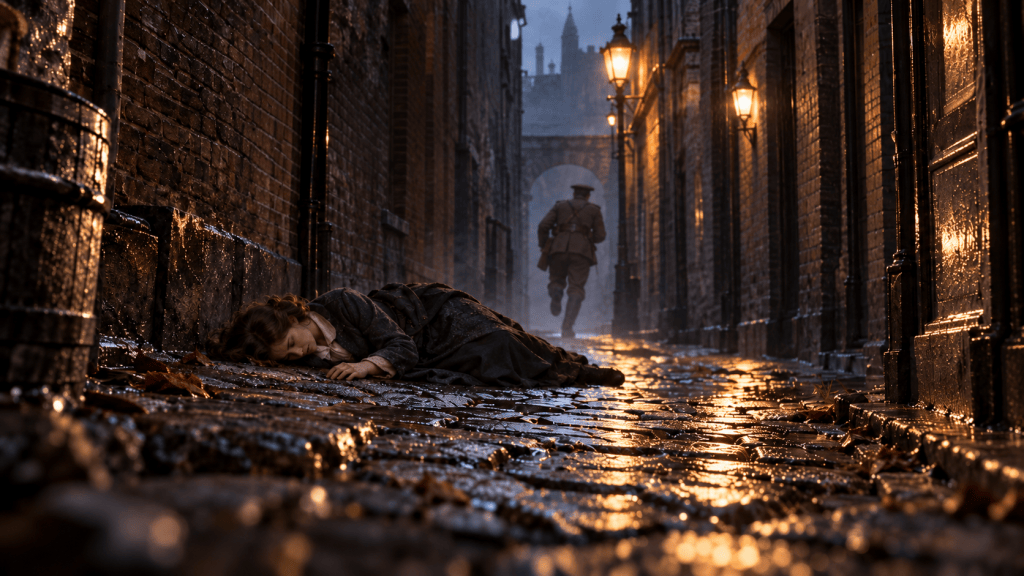
1920. Bessie Carberry is found dead in Dublin
In the early hours of 27 October 1920 the body of Elizabeth “Bessie” Carberry was found in a laneway off Dame Street. She was about thirty, unmarried, under five feet, and lived at 8 Vicar Street. Neighbours had heard a long argument between her and a British soldier with whom she had been drinking.
Two doctors examined her separately. There was heavy bruising to the jaws, a severe bruise behind the left ear, and another on the right thigh. The larynx was intact. She had not been throttled. Death was from suffocation: a hand held over the mouth. Her clothes were disarranged. A policeman said her legs were doubled under her. Near the body lay a cap badge of the King’s Own Royal Lancaster Regiment, then in Dublin.
Lance Corporal Albert Hadley of that regiment was taken by a curfew patrol nearby. His badge was missing. The knees of his trousers were wet. The coroner, Dr Louis A. Byrne, directed a verdict of murder “against a soldier unknown.” No charge of sexual assault was laid.
Hadley was court-martialled for murder, with manslaughter as an alternative, in February 1921. Another soldier from the same unit had also lost a cap badge in Dublin that night. The court dismissed the case for insufficient evidence. The defence did not have to open. The killer was never legally named. Breathnach and O’Halpin place the death among cases that look personal rather than political. She was not an IRA target. There is no evidence of an official Crown operation against her. The war was the setting, not the proven motive.
1920. Kevin Barry is given a date

Kevin Barry. Keogh Brothers portrait. Tried 20 October; hanged 1 November.
Kevin Barry had been tried by general court-martial on 20 October for the Monk’s Bakery attack in Upper Church Street on 20 September. Three British soldiers died. He was taken at the lorry. He refused to recognise the court. That evening the sentence was read in his cell: death by hanging.
Secondary chronologies place on 27 October the order from General Sir Nevil Macready to the governor of Mountjoy that the sentence be carried out on Monday, 1 November, and the notice to Barry. The date became public on 28 October. The 20 October trial and the 1 November hanging are fixed. The 27 October prison paper still wants the original file.
Clemency appeals were already coming from clergy, unions, women’s groups, some unionists, and former officers at UCD and Trinity. Macready held that hanging would steady the army and the police. There was no reprieve.
References
References
Breathnach, C. and O’Halpin, E. (2022) ‘Sexual assault and fatal violence against women during the Irish War of Independence, 1919–1921: Kate Maher’s murder in context’, Medical Humanities, 48(1), 94–103. mh.bmj.com/content/48/1/94. Open copy: TARA.
University College Dublin, ‘Kevin Barry and His Time’. ucd.ie/library/exhibitions/barry. Also Google Arts & Culture.
Irish History 1919–1923 Chronology, ‘October 1920’. irishhistory1919-1923chronology.ie/october_1920.htm. Places Macready’s order and the notice to Barry on 27 October; public date 1 November announced 28 October. Archival confirmation still wanted for the 27 October paper.
.

Leave a comment