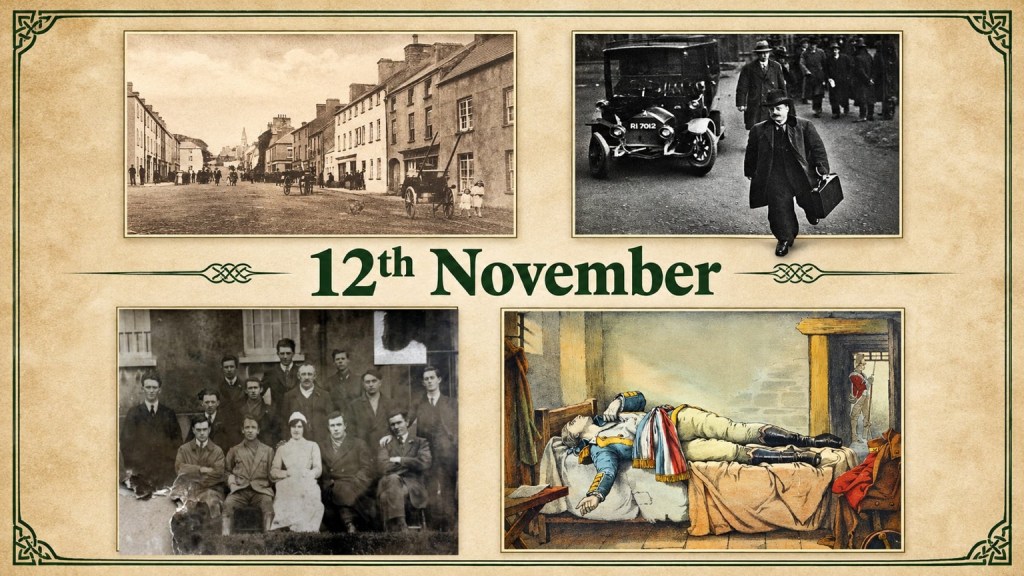
1798 — Wolfe Tone Cuts His Throat in Prison
On 12 November 1798, two days after being sentenced to death by court martial, Theobald Wolfe Tone was found in his cell in Dublin with a severe wound to his throat. The wound was self-inflicted. Contemporary and later accounts traditionally describe this as a suicide attempt, although the Dictionary of Irish Biography cautions that Tone may instead have been trying to delay his execution long enough for legal intervention to save him.
His friends John Philpot Curran and Peter Burrowes successfully obtained a stay on the grounds that Tone, a French officer rather than a British soldier, should not have been tried by court martial while the civil courts were sitting. By then, however, he was too badly wounded to be moved. Tone lingered for a week and died on 19 November 1798, aged 35.
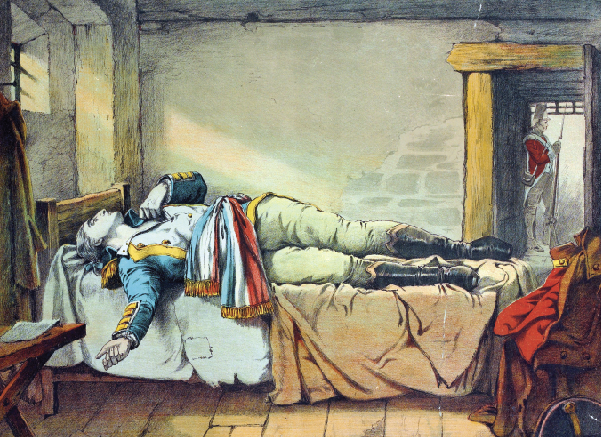
1920 — The Cork Hunger Strike Ends After 94 Days
On 12 November 1920, the surviving republican prisoners in Cork Gaol ended their hunger strike after 94 days. The protest had begun on 11 August. Eleven men eventually formed the core group of hunger strikers, demanding release from imprisonment. Michael Fitzgerald died on 17 October after 67 days without food, and Joseph Murphy died on 25 October after 76 days. Terence MacSwiney, arrested separately in Cork and transferred to Brixton Prison, had died on hunger strike in London earlier on 25 October.
Acting Dáil President Arthur Griffith directed the remaining men to end their fast, telling them that they had sufficiently proved their devotion and should now prepare to live for Ireland. Lord Mayor Donal Óg O’Callaghan spent much of 12 November in Cork Gaol persuading the prisoners to accept the decision. That evening, the nine survivors took food for the first time in 94 days.
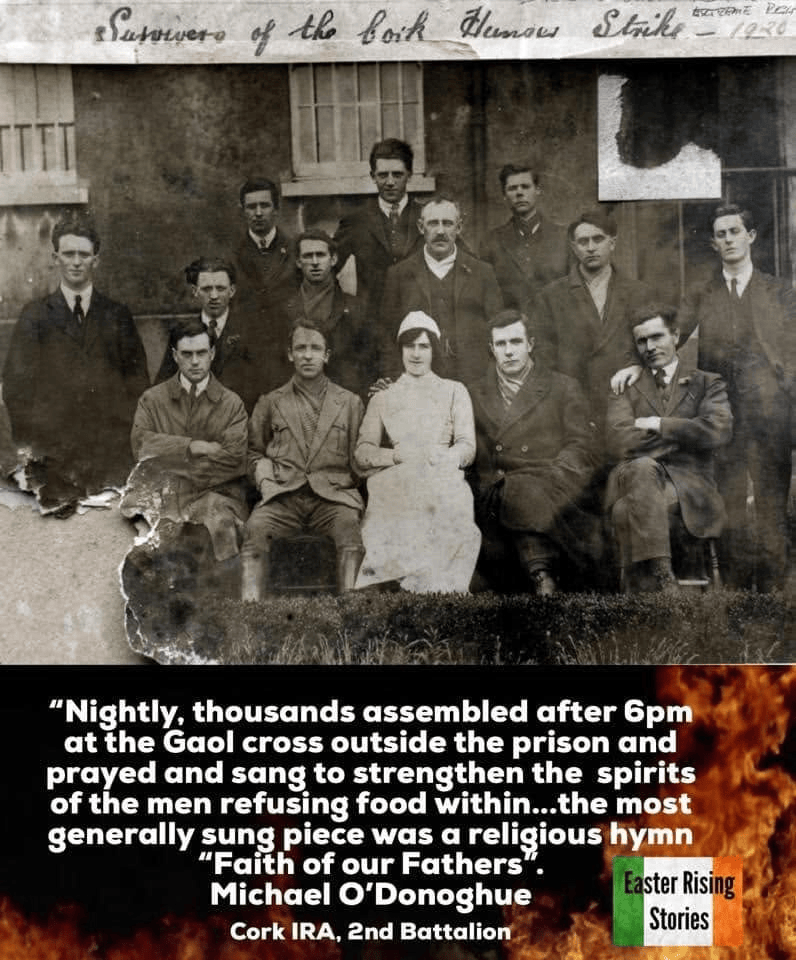
1921 — Griffith Meets Lloyd George Over Ulster
On 12 November 1921, Arthur Griffith met David Lloyd George privately in London as the Treaty negotiations reached a critical stage. Lloyd George outlined a proposal for an all-Ireland parliament, with Northern Ireland entitled to opt out within twelve months. If it did so, a Boundary Commission would then determine the border.
Griffith did not formally accept the proposal. Instead, he told Lloyd George that the scheme was the British government’s proposal and that he could not guarantee its acceptance by his colleagues. What he did promise was that the Irish delegation would not publicly repudiate it while Lloyd George was confronting Ulster opposition. This distinction later became highly significant during the final Treaty negotiations.
1922 — Civilian Jeremiah McKenna Dies in Kerry
On 12 November 1922, Jeremiah McKenna, a civilian from the Milltown–Castlemaine area of County Kerry, died from gunshot wounds sustained several days earlier. His mother Mary McKenna was also wounded in the same incident.
One version of events describes the pair as being caught during an anti-Treaty ambush on a National Army cycle patrol, while more recent research into Civil War fatalities states that they were shot by a passing National Army patrol near Milltown.
Harvard References
Dictionary of Irish Biography (2009) ‘Tone, Theobald Wolfe’. Royal Irish Academy. Available at: https://www.dib.ie/biography/tone-theobald-wolfe-a8590 (Accessed: 10 November 2026).
Doherty, G. (2021) ‘Cork Hunger Strike, 1920’, The Irish Revolution, University College Cork. Available at: https://www.ucc.ie/en/theirishrevolution/feature-articles/cork-hunger-strike-1920.html (Accessed: 10 November 2026).
University College Cork (n.d.) ‘Volunteer (Patrick) Joseph Murphy’, Cork Fatality Register, entry 1920-95. Available at: https://www.ucc.ie/en/theirishrevolution/collections/cork-fatality-register/register-index/1920-95/ (Accessed: 10 November 2026).
Documents on Irish Foreign Policy (1921) ‘Arthur Griffith to Eamon de Valera, 12 November 1921’, Documents on Irish Foreign Policy, Vol. 1, document 194. Available at: https://www.difp.ie/volume-1/1921/anglo-irish-treaty/194/ (Accessed: 10 November 2026).
Documents on Irish Foreign Policy (1921) ‘Arthur Griffith to Eamon de Valera, 9 November 1921’, Documents on Irish Foreign Policy, Vol. 1, document 192. Available at: https://www.difp.ie/volume-1/1921/anglo-irish-treaty/192/ (Accessed: 10 November 2026).
RTÉ History (2024) ‘The most violent county: Civil War deaths in Kerry’. Available at: https://www.rte.ie/history/civil-war-fatalities/2024/0304/1435938-the-most-violent-county-civil-war-deaths-in-kerry/ (Accessed: 10 November 2026).
Irish History 1919–1923 Chronology (n.d.) ‘November 1922’. Available at: http://irishhistory1919-1923chronology.ie/november_1922.htm (Accessed: 10 November 2026).
History Ireland (n.d.) ‘Wolfe Tone and the Culture of Suicide in Eighteenth Century Ireland’ Available at: https://historyireland.com/wolfe-tone-culture-suicide-eighteenth-century-ireland/ (Accessed: 10 November 2026)
Coffey, P. (2021) This Day in Irish History: From the Social Media Sensation @ThisDayIrish. Dublin: The O’Brien Press.


Leave a Reply