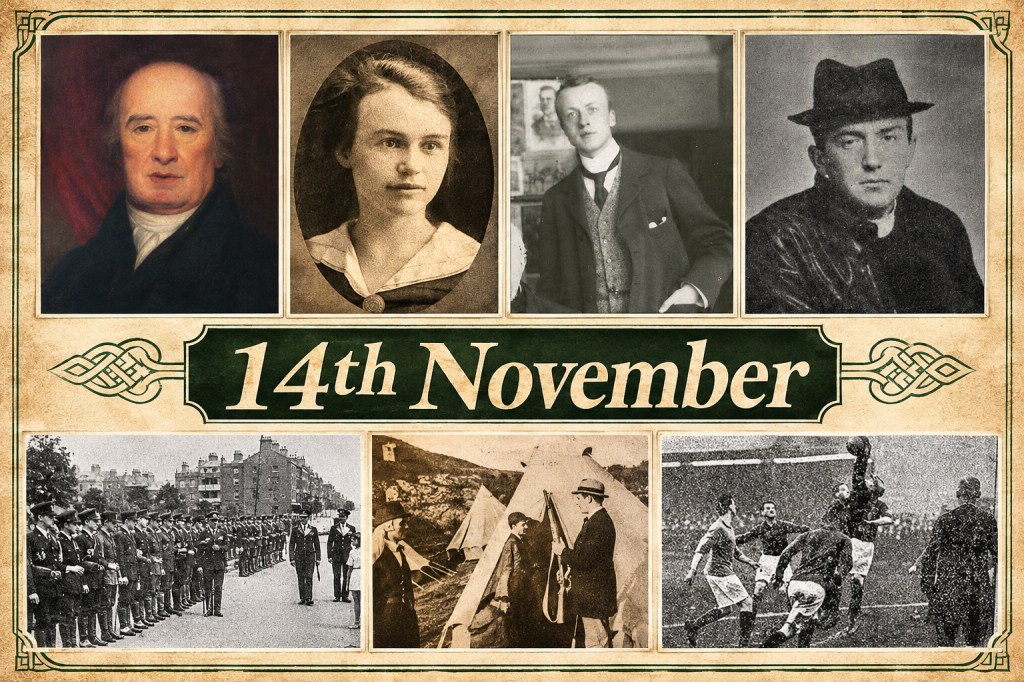
1827 — Death of Thomas Addis Emmet
On 14 November 1827, Thomas Addis Emmet, senior United Irishman and elder brother of Robert Emmet, died in New York after collapsing while arguing a case in court. Following the failure of the United Irish movement, Emmet had been imprisoned and later settled in the United States, where he became one of New York’s leading lawyers and briefly served as Attorney General of New York State.
Emmet remained closely associated with Irish-American political life and famously expressed the wish not to return to Ireland while it remained under British rule. His career shows how the United Irish generation continued to influence politics and public life far beyond Ireland after 1798.
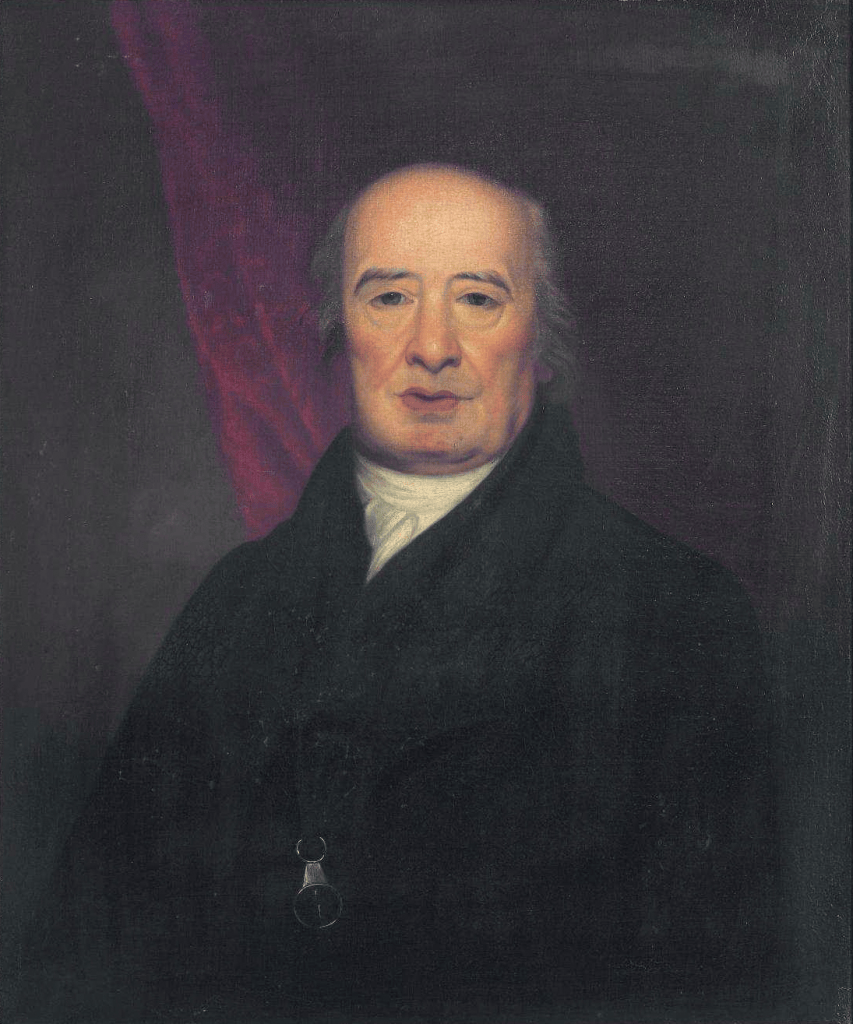
1892 — Birth of Nora Connolly
Nora Connolly O’Brien was born at 6 Lothian Street, Edinburgh, on 14 November 1892, the second daughter of James and Lillie Connolly. Raised in a strongly socialist and republican household, she became active in the Belfast branch of Cumann na mBan and worked closely with the Irish Volunteers before the Easter Rising.
During Easter 1916 she carried messages between Dublin and northern Volunteers, including instructions connected with the confused mobilisation in Tyrone. She later became a Labour senator, republican activist and an important chronicler of her father and the revolutionary period.
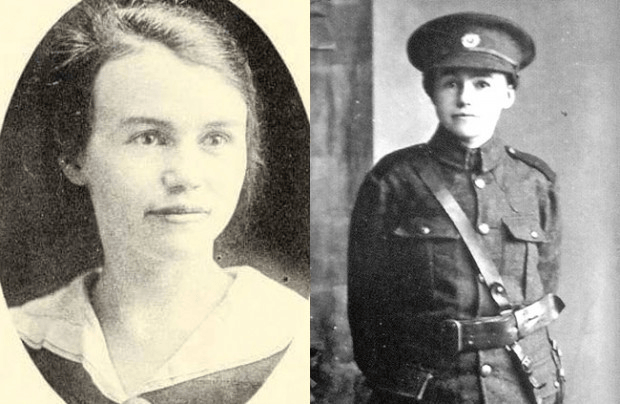
1918 — Death of Seumas O’Kelly
On 14 November 1918, writer and journalist Seumas O’Kelly died in Jervis Street Hospital, three days after disturbances at the Sinn Féin newspaper offices in Harcourt Street during the Armistice celebrations. O’Kelly, then editor of Nationality, suffered a cerebral haemorrhage during the attack. He was 38 years old.
A novelist, playwright and short-story writer, O’Kelly was later best remembered for The Weaver’s Grave. His funeral to Glasnevin became a major nationalist demonstration, reflecting both his literary reputation and the circumstances of his death.
1920 — Fr Michael Griffin Disappears in Galway
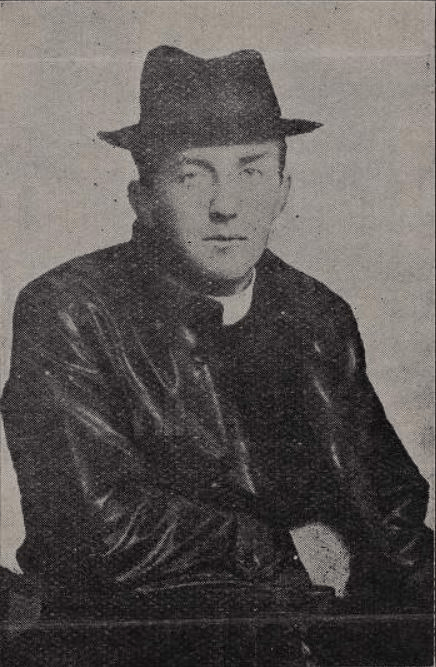
Late on 14 November 1920, Fr Michael Griffin, a 28-year-old Catholic priest in Galway, was called from his home at Montpellier Terrace on what appeared to be an urgent sick call. He left with several men and was never seen alive again. Six days later, his body was found buried near Barna, with a gunshot wound to the head.
Suspicion quickly centred on the Auxiliaries stationed at Lenaboy Castle. British authorities publicly denied Crown-force involvement, but former Auxiliary commander Frank Crozier later alleged that Auxiliaries had killed Griffin and that evidence had been suppressed. Later republican testimony also claimed that William Joyce, who would later become notorious as “Lord Haw-Haw”, may have helped lure Griffin from the house. That allegation remains based on retrospective testimony rather than definitive proof.
1921 — Guns Drawn at a Louth Football Final
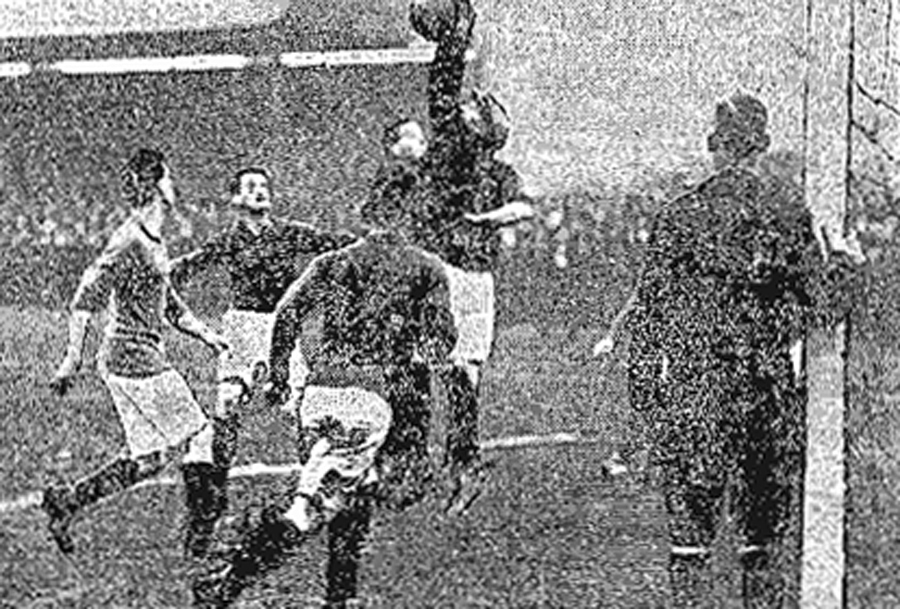
On 14 November 1921, tensions between rival IRA groups erupted during the Louth county junior football final between Boyne Rangers of Drogheda and Clan na Gael of Dundalk. Contemporary research records that weapons were drawn on two occasions during the match.
The local Republican Police chief described the episode as “very discreditable to the national movement”. The incident is a revealing glimpse of the growing strains within the republican movement only weeks before the Anglo-Irish Treaty was signed.
1922 — Garda Henry Phelan is Shot Dead
On 14 November 1922, Garda Henry “Harry” Phelan was shot dead in a shop in Mullinahone, County Tipperary. Phelan, aged 21, had joined the newly established Civic Guard only six months earlier and had travelled from Callan with colleagues to buy hurleys and sporting equipment. Two armed men entered the premises and Phelan was shot without warning.
He became the first member of the new Garda Síochána to be killed in service and the only Garda killed during the Civil War. The shooting was widely condemned. In December 1922, anti-Treaty IRA GHQ issued a general order that unarmed Civic Guards were not to be fired upon, reflecting an effort to keep the new unarmed police force outside the military conflict.
References
Dictionary of Irish Biography (2011) ‘Emmet, Thomas Addis’. Royal Irish Academy. Dictionary of Irish Biography — Thomas Addis Emmet
Historical Society of the New York Courts (n.d.) ‘Thomas Addis Emmet’. New York Courts — Thomas Addis Emmet
Dictionary of Irish Biography (2009) ‘O’Brien, Nora Connolly’. Royal Irish Academy. Dictionary of Irish Biography — Nora Connolly O’Brien
Military Archives of Ireland (n.d.) ‘Nora Connolly-O’Brien’. Military Archives — Nora Connolly O’Brien
Kildare County Council Local Studies (2018) ‘Death of Seumas O’Kelly, 100 years ago today’. Kildare eHistory — Seumas O’Kelly
Dictionary of Irish Biography (2009) ‘O’Kelly, Seumas’. Royal Irish Academy. Dictionary of Irish Biography — Seumas O’Kelly
Galway City Museum (2020) ‘The Disappearance and Discovery of Fr Michael Griffin’. Galway City Museum — Fr Michael Griffin
RTÉ Brainstorm (2020) ‘The strange, gruesome murder of a Galway priest 100 years ago’. RTÉ Brainstorm — Fr Michael Griffin
Irish History 1919–1923 Chronology (n.d.) ‘November 1921’. November 1921 chronology
An Garda Síochána (n.d.) ‘Phelan, Henry’. Garda Roll of Honour — Henry Phelan
RTÉ (2022) ‘Policing the revolution: Order from chaos’. RTÉ — The early Civic Guard
Irish History 1919–1923 Chronology (n.d.) ‘December 1922’. December 1922 chronology


Leave a Reply