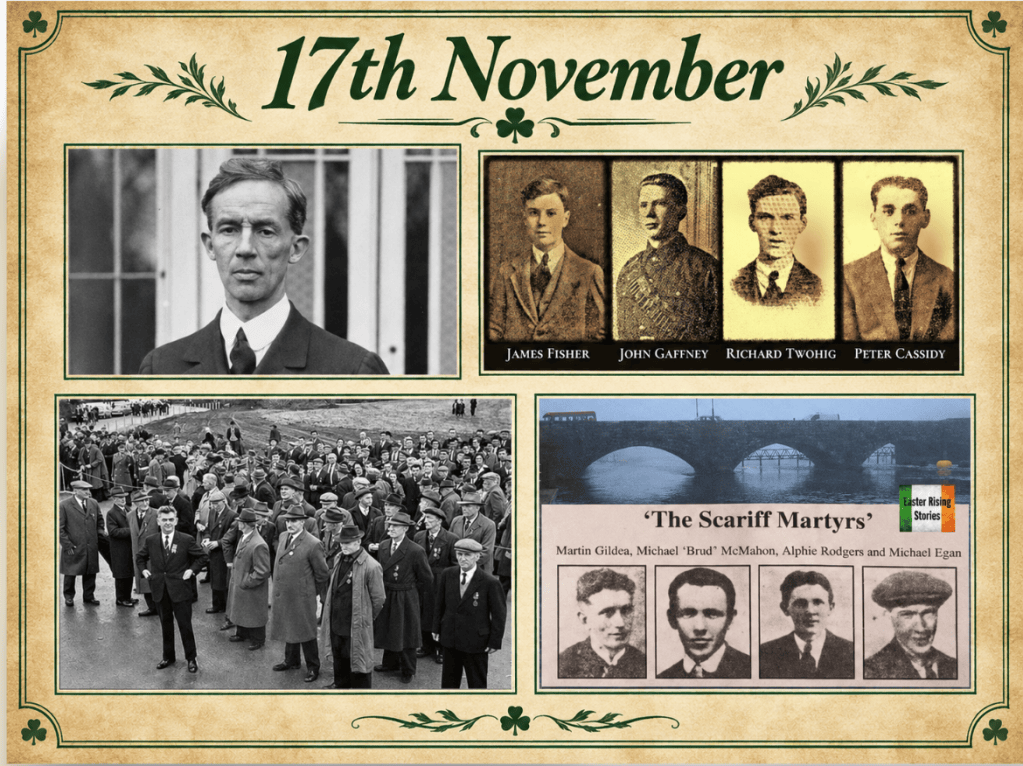
1919 — IRA Raids a Royal Navy Motor Launch at Bantry
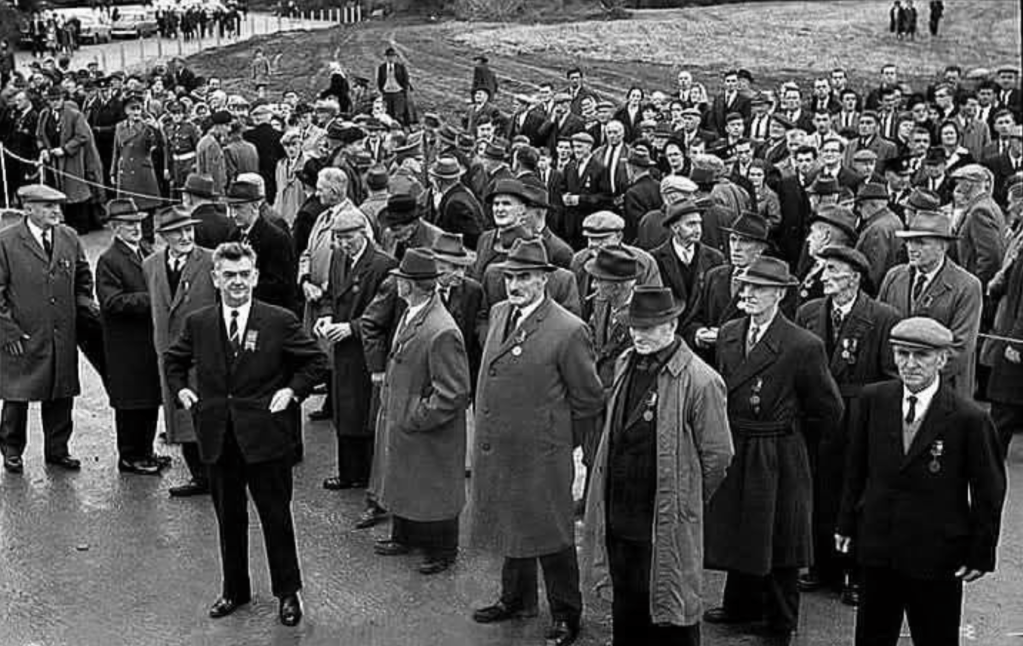
Veterans years later of the Cork No. 3 Brigade (with Tom Barry)
On the night of 17 November 1919, about ten IRA Volunteers from the Bantry area boarded Royal Navy Motor Launch No. 171, which was tied up at Bantry Pier. The party included Mossie Donegan, Ralph Keyes, Seán Cotter and Michael O’Callaghan. They surprised the crew, confined them below deck and broke into the vessel’s armoury.
The Volunteers captured six Ross rifles, three Webley revolvers and ammunition, together with other military equipment. Bureau of Military History testimony later recalled that local RIC had warned the naval officer against tying up at the pier. The raid became an important early source of arms for the Cork No. 3 Brigade and demonstrated the IRA’s willingness to exploit poorly guarded military installations.
1920 — Four Prisoners Shot Dead at Killaloe Bridge
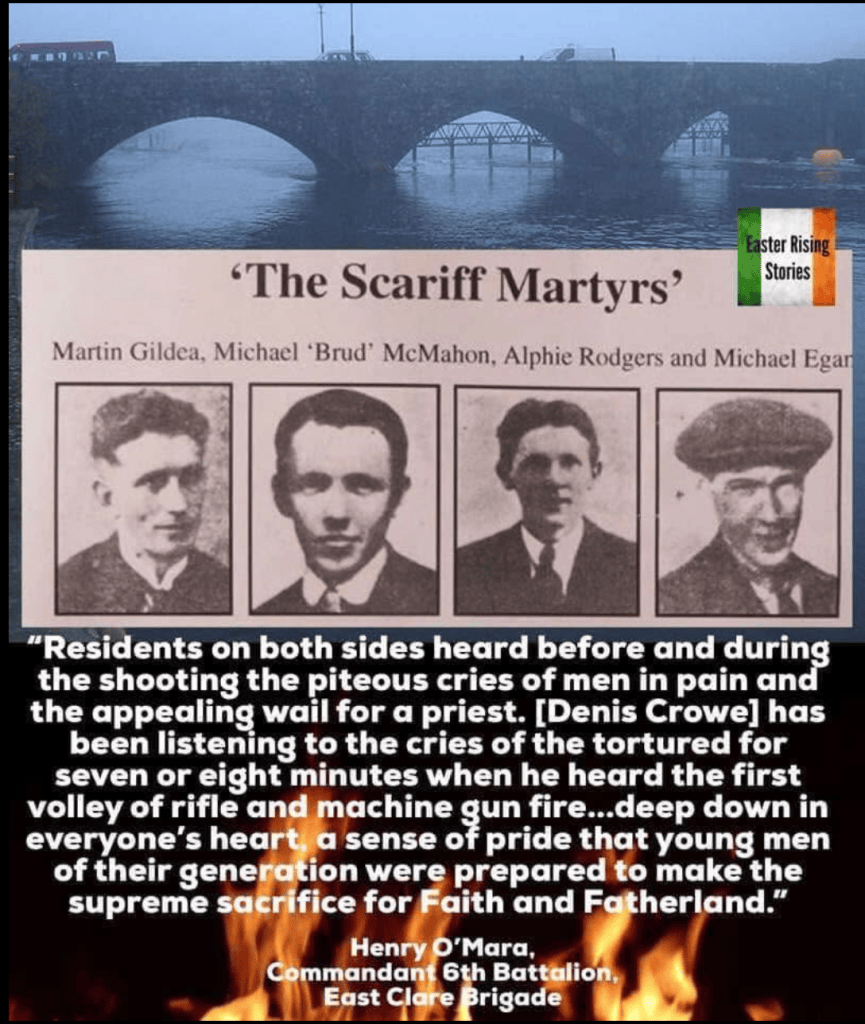
Scariff Martyrs
Shortly after midnight on 17 November 1920, four prisoners — Alphonsus “Alphie” Rodgers, Michael “Brud” McMahon, Martin Gildea and Michael Egan — were shot dead on Killaloe Bridge, linking County Clare with Ballina in County Tipperary. Three were IRA Volunteers; Egan was the civilian caretaker of Williamstown House, where the others had been staying.
The British government claimed in the House of Commons that the men had attempted to escape from custody and were shot after failing to halt. Local accounts and later research strongly disputed that version, pointing to evidence that the men were bound and had been badly treated before their deaths. A coroner’s jury later returned a verdict of wilful murder against Crown forces. Because the shootings occurred around midnight, some memorial sources date the killings to 16 November, while Hansard gives 12.30 a.m. on 17 November.
Michael Daly, a civilian railway worker who was the first to cross the bridge, who had a pass during curfew has also said “I crossed to prepare for the departure of the early train to Limerick. I saw pools of blood on the bridge. On my way back I examined it and I saw what I thought was brain matter mixed with it. I found a cap, which I discovered afterwards was Brud McMahon’s. All the pools of blood were in the same place. I marked the spot and that is where the plaque now stands.”
During the funeral the hearses were not allowed to come nearer than half a mile away from the bridge. A black flag was flown from the police barracks and Crossley tenders of Black and Tans, carrying black flags, cleared the streets.
He also describes in the quote in the photo below that after the outraged faces and grief of the onlookers in the Church when they finally got to view the bodies in the coffins, it was followed by a sense of pride that their generation put their lives on the line for their country.
Tomas Mac Conmara has also written a great book on The Scariff Martyrs.
There is a good discussion with him here about the event recorded on Trasna na Tire.
1921 — Unionist Conference in Liverpool Rejects a Hard-Line Motion
Here is footage from the event:
On 17 November 1921, a large conference of Unionists and Conservatives from Britain and Ireland met in Liverpool as the Anglo-Irish negotiations entered a critical phase. A resolution condemning the British government for negotiating with Sinn Féin was defeated. Contemporary political correspondence recorded a strong desire among delegates to avoid civil war and not to break up the negotiations until every possibility of agreement had been explored.
The meeting mattered because Lloyd George was facing pressure from Conservative “die-hards” who strongly opposed any coercion of Northern Ireland. Their inability to turn the Liverpool gathering into an outright rejection of negotiations gave the government greater room to continue the talks. On the same day, Éamon de Valera wrote to Arthur Griffith arguing that the Irish side should now send Britain its “final word” in the negotiations.
1922 — The First Civil War Executions
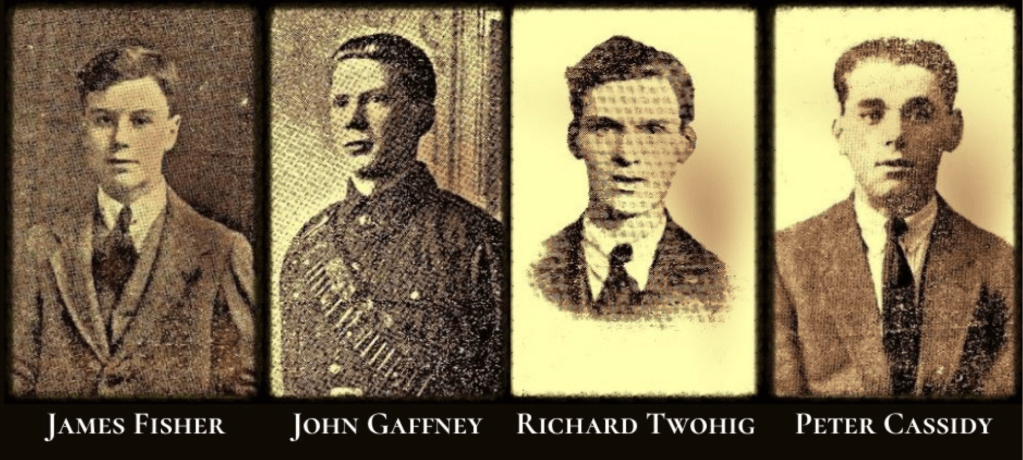
At 7 a.m. on 17 November 1922, four young anti-Treaty IRA Volunteers — Peter Cassidy, James Fisher, John Gaffney and Richard Twohig — were executed by firing squad in Kilmainham Gaol. Each had been convicted by military court of possessing a revolver without lawful authority. They were the first prisoners executed under the government’s new Civil War execution policy.
All four were young working-class Dubliners, and none was permitted a final visit from relatives. Their deaths opened a new and much harsher phase of the Civil War: over the following months, 81 anti-Treaty prisoners would be executed by the state. The policy was justified by the government as necessary to suppress armed resistance, but it became one of the most controversial aspects of the conflict.
1922 — Erskine Childers Sentenced to Death
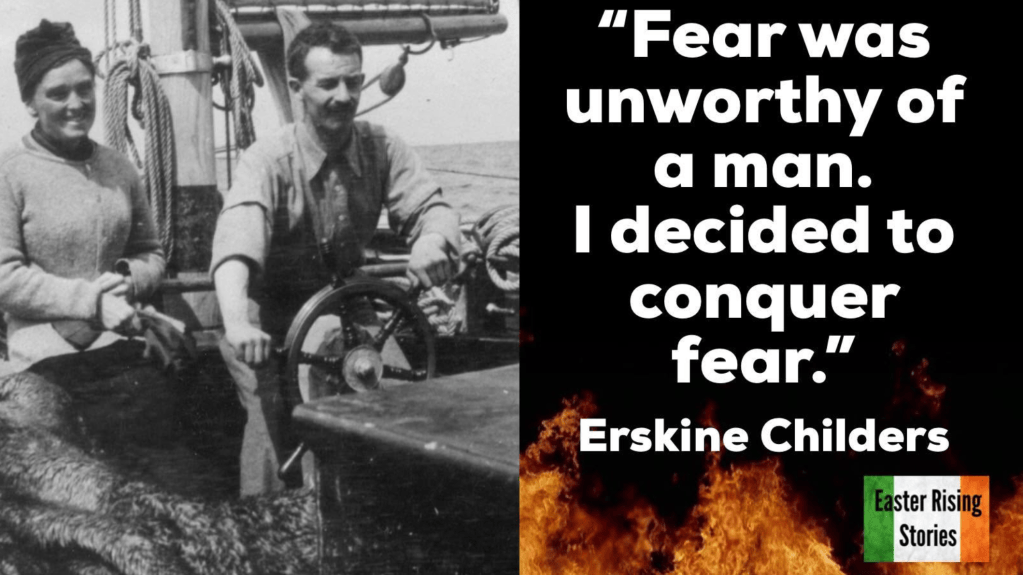
Also on 17 November 1922, Erskine Childers was brought before a military court and charged with unlawful possession of a small automatic pistol found when he was arrested at Glendalough House, County Wicklow. The weapon had famously been given to him by Michael Collins before the Treaty split.
Childers was found guilty and sentenced to death. One week later, on 24 November, he was executed by firing squad at Beggars Bush Barracks. His case became one of the most politically charged executions of the Civil War because of his prominence as a writer, former Treaty negotiator and anti-Treaty publicist. Before the 1916 Easter Rising Childers had smuggled guns to help arm the Irish Volunteers on board his boat The Asgard.
Here is an interesting documentray about his life:
References
Bureau of Military History (n.d.) Witness Statement 1455. Dublin: Military Archives of Ireland. Available at: https://bmh.militaryarchives.ie/reels/bmh/BMH.WS1455.pdf (Accessed: 16 November 2026).
Bureau of Military History (n.d.) Witness Statement 1478. Dublin: Military Archives of Ireland. Available at: https://bmh.militaryarchives.ie/reels/bmh/BMH.WS1478.pdf (Accessed: 16 November 2026).
Bureau of Military History (n.d.) Witness Statement 1493. Dublin: Military Archives of Ireland. Available at: https://bmh.militaryarchives.ie/reels/bmh/BMH.WS1493.pdf (Accessed: 16 November 2026).
Hansard (1920) ‘Escaping Prisoners (Shooting)’, House of Commons Debates, 18 November. Available at: https://hansard.parliament.uk/Commons/1920-11-18/debates/b86895ab-098c-4836-b8ff-80567b4a63bb/EscapingPrisoners%28Shooting%29 (Accessed: 16 November 2026).
Mac Conmara, T. (2021) The Scariff Martyrs: War, Murder and Memory in East Clare. Cork: Mercier Press.
RTÉ/Century Ireland (n.d.) ‘Further deaths in ambushes and reprisals around the country’. Available at: https://www.rte.ie/centuryireland/articles/further-deaths-in-ambushes-and-reprisals-around-the-country (Accessed: 16 November 2026).
House of Commons Library (2021) The Anglo-Irish Treaty, 1921. London: House of Commons Library. Available at: https://researchbriefings.files.parliament.uk/documents/CBP-9260/CBP-9260.pdf (Accessed: 16 November 2026).
Irish History 1919–1923 Chronology (n.d.) ‘November 1921’. Available at: https://irishhistory1919-1923chronology.ie/november_1921.htm (Accessed: 16 November 2026).
Office of Public Works (2022) ‘“I am to die for Ireland”: Civil War Executions in Kilmainham Gaol’. Available at: https://www.gov.ie/en/office-of-public-works/press-releases/i-am-to-die-for-ireland-civil-war-executions-in-kilmainham-gaol-opw-presents-kilmainham-gaol-museum-exhibition-on-the-first-state-executions-of-the-civil-war-17-november-2022-to-31-march-2023/ (Accessed: 16 November 2026).
RTÉ (2022) ‘Irish State executions — a new phase in the Civil War’. Available at: https://www.rte.ie/news/ireland/2022/1117/1336580-gaffney-fisher-cassidy-twohig/ (Accessed: 16 November 2026).
RTÉ History (2022) ‘Sentenced to death: the Civil War executions’. Available at: https://www.rte.ie/history/2022/0830/1319631-sentenced-to-death-the-civil-war-executions/ (Accessed: 16 November 2026).
The Auxiliary Division of the Royal Irish Constabulary (n.d.) ‘Killaloe Bridge Murders – 17 Nov 1920’. Available at: The Auxiliaries — Killaloe Bridge Murders (Accessed: 16 November 2026).


Leave a Reply