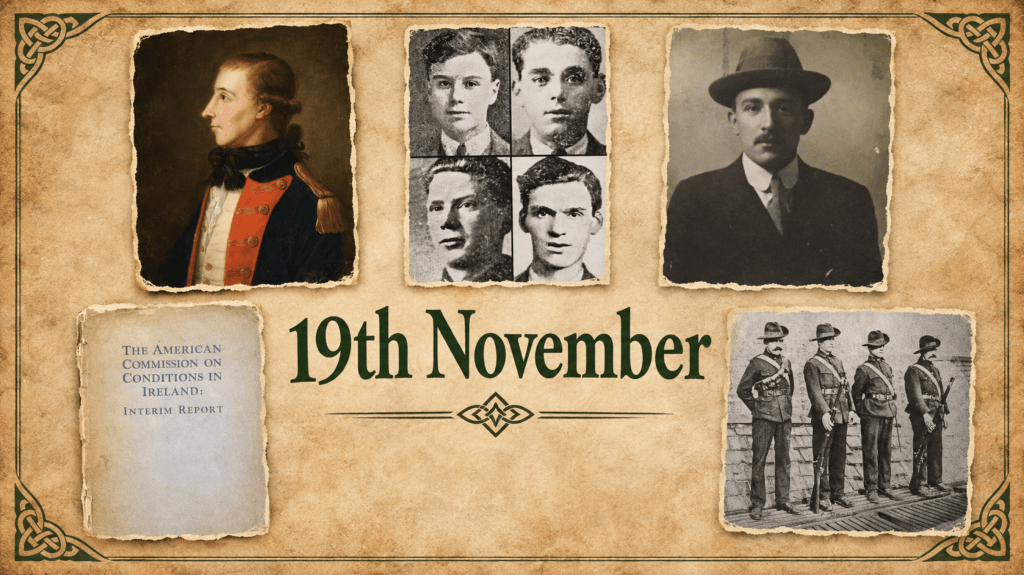
1798 — Death of Theobald Wolfe Tone

On 19 November 1798, Theobald Wolfe Tone died in the Provost Prison at the Royal Barracks in Dublin, aged 35. Captured after the defeat of the French expedition at Tory Island, Tone had been court-martialled in Dublin and sentenced to death. He subsequently suffered a severe self-inflicted wound to his throat and survived for several days before dying.
Tone had been one of the founders and leading strategists of the Society of United Irishmen and had spent years attempting to secure French military assistance for an Irish revolution. He was buried at Bodenstown, County Kildare, on 21 November 1798, where his grave later became one of the principal sites of republican commemoration.
1913 — The Irish Citizen Army is Formed
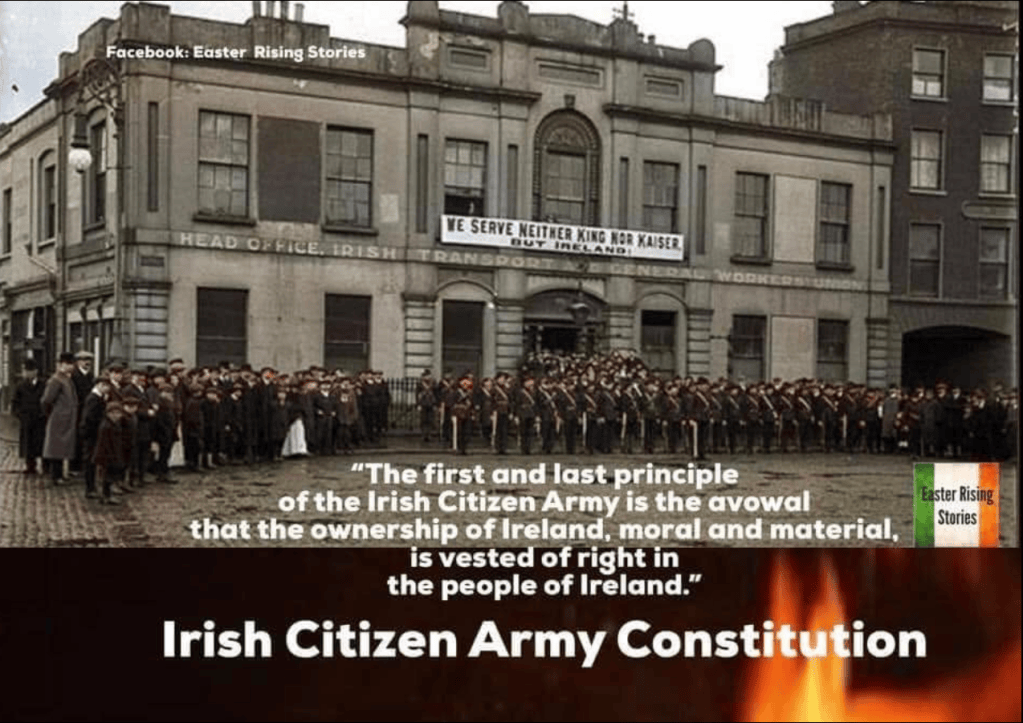
Irish Citizen Army outside Liberty Hall
On 19 November 1913, amid the Dublin Lockout, workers gathered outside Liberty Hall and the Irish Citizen Army began to take organised form. The initiative was led principally by James Larkin, James Connolly and Captain Jack White as a means of protecting workers from police violence and giving them disciplined training.
Initially equipped largely with sticks and hurleys, the Citizen Army subsequently acquired weapons, uniforms and a more formal military organisation. Under Connolly and Michael Mallin it would fight alongside the Irish Volunteers during the Easter Rising of 1916.
Although some sources attach other November dates to stages in its development, the National Library of Ireland, RTÉ/Century Ireland and contemporary commemorative chronologies support 19 November 1913 as the conventional foundation date.
1919 — James Hurley Wrongly Arrested for the Shooting of Detective Wharton
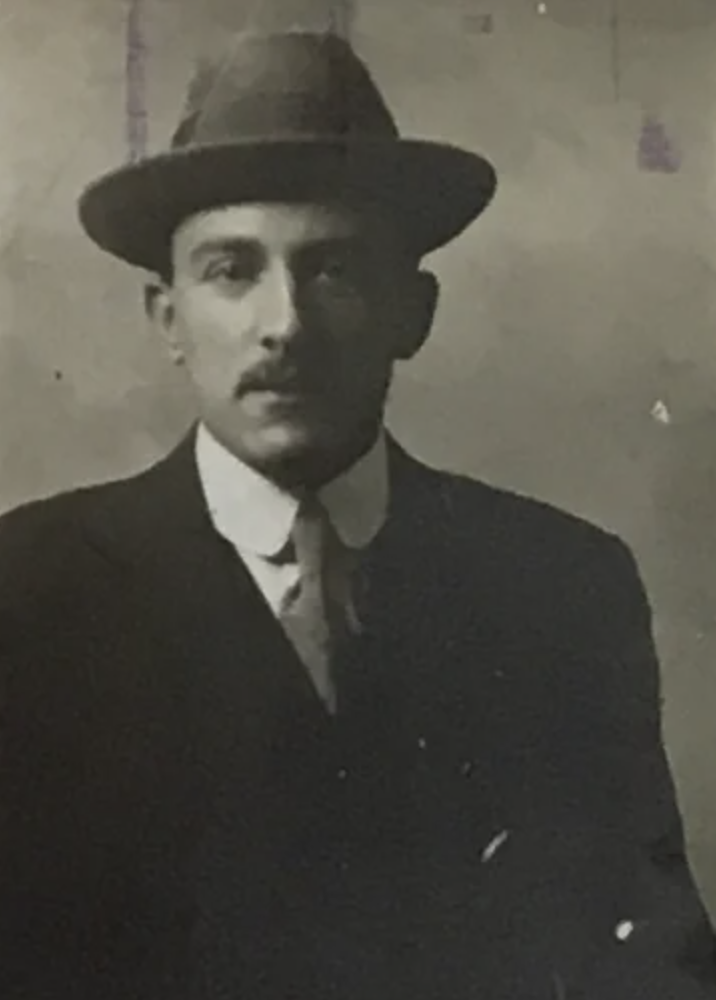
Detective Thomas Wharton
On 19 November 1919, James Hurley, a newspaper seller and former British Army soldier, was arrested in connection with the attempted assassination of DMP Detective Thomas Wharton, who had been shot at the junction of Harcourt Street and Cuffe Street nine days earlier.
Hurley had no involvement in the attack. Nevertheless, he was convicted by military court on the basis of mistaken eyewitness identification and sentenced to 15 years’ penal servitude. He remained imprisoned until after the Truce of July 1921.
His story had a tragic postscript. During the opening stages of the Civil War in 1922, Hurley was killed while helping a wounded soldier towards Jervis Street Hospital.
1920 — American Inquiry into Conditions in Ireland Continues in Washington
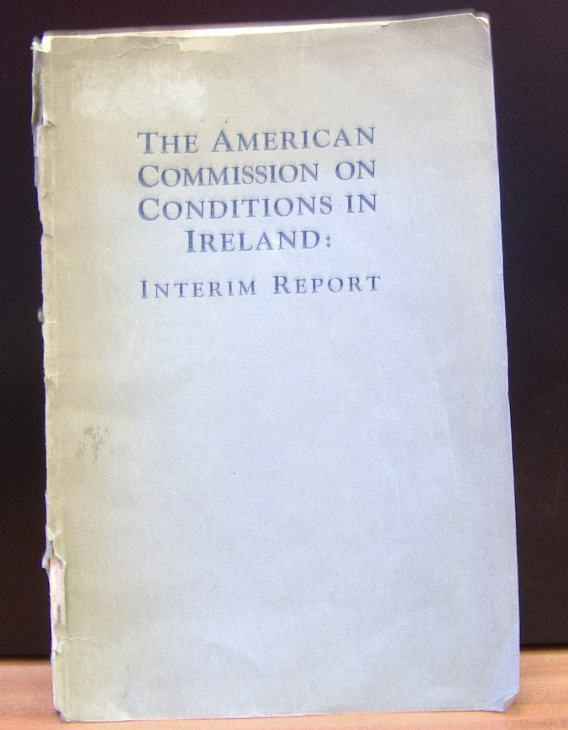
On 19 November 1920, the American Commission on Conditions in Ireland continued its first public hearings at the Hotel Lafayette in Washington, D.C. The Commission had been created following an initiative by the American journal The Nation and included prominent American public figures such as Jane Addams, Frederic C. Howe, James H. Maurer, David I. Walsh and L. Hollingsworth Wood.
The first hearing had actually opened on 18 November, rather than the 19th. Witnesses gave evidence concerning reprisals, destruction of property, arrests and the behaviour of British forces in Ireland. British officials declined to participate officially, although the Commission stated that it wished to hear evidence from all sides.
The inquiry continued through January 1921 and became an important element in the struggle to influence American opinion about the conflict in Ireland. Here is a video about it.
1922 — Thomas Whelan Dies After the Blackhorse Bridge Mine Explosion
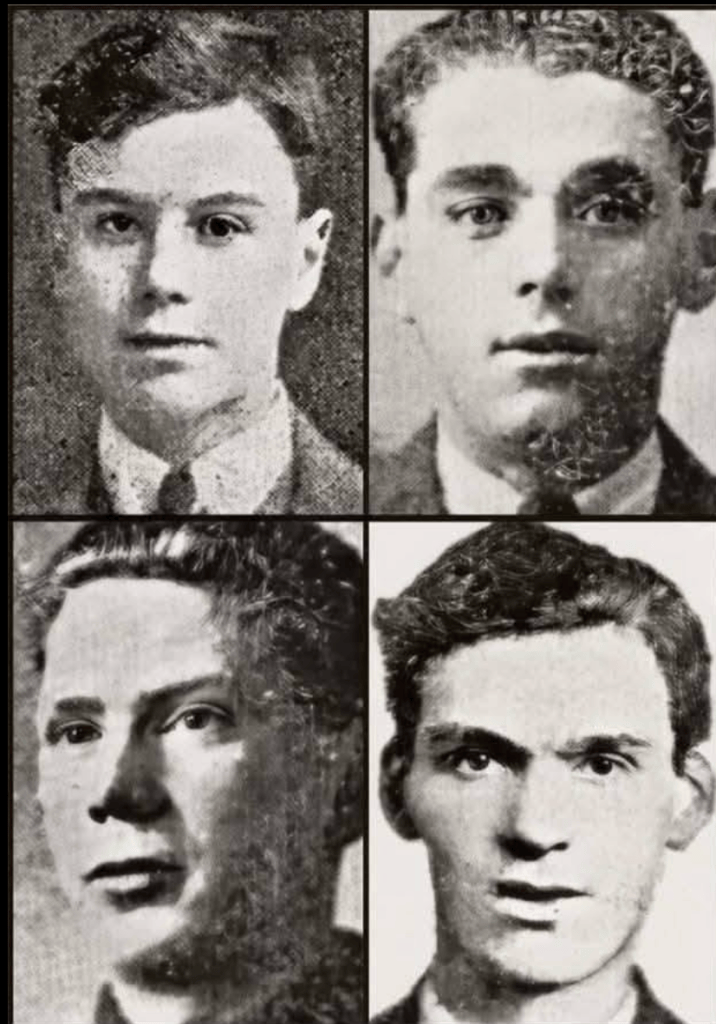
Four men who died
In the early hours of 19 November 1922, anti-Treaty IRA Volunteer Thomas S. Whelan, aged 22, died in Dr Steevens’ Hospital from injuries suffered when a land mine exploded accidentally near Blackhorse Bridge on the Naas Road, outside Inchicore.
The explosion had occurred on the evening of 18 November while an anti-Treaty party was preparing a mine for use against National Army forces. Thomas Maguire, Patrick Egan and Bernard Curtis were killed in the explosion itself. Whelan was seriously wounded, underwent an amputation, and died the following morning.
The incident was one of the deadliest accidental explosions involving anti-Treaty forces during the Civil War and demonstrates the dangers inherent in the improvised mine warfare used during the guerrilla phase of the conflict.


Leave a Reply