20 NOVEMBER
1920 — The Body of Fr Michael Griffin is Found
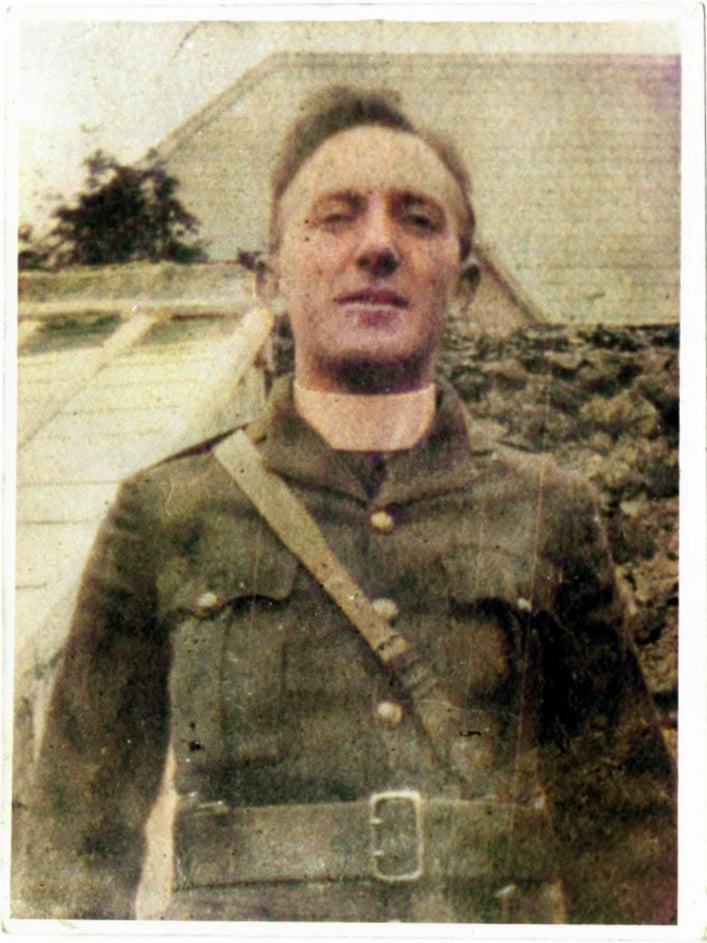
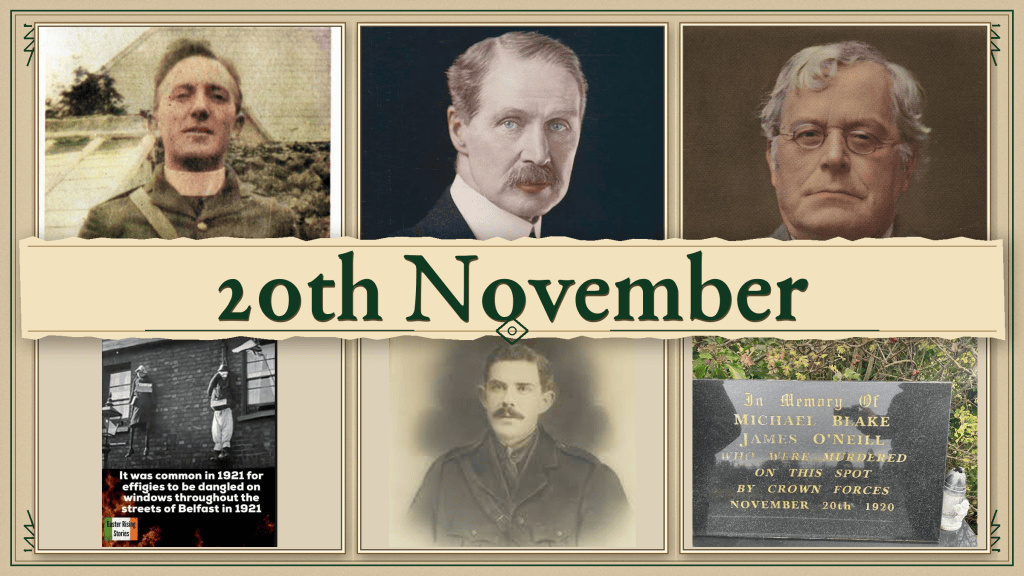
On 20 November 1920, the body of Fr Michael Griffin, a 28-year-old Catholic priest from Galway, was discovered buried in boggy ground near Barna, County Galway. He had disappeared six days earlier after being called from his home on what appeared to be an urgent sick call. A post-mortem showed that he had been shot in the head.
Suspicion centred on members of the Auxiliary Division stationed at Lenaboy Castle, although no one was convicted of his murder. His killing caused widespread outrage in Ireland and abroad and became one of the most notorious cases associated with Crown-force violence during the War of Independence.
1920 — James O’Neill and Michael Blake Killed after Acquittal
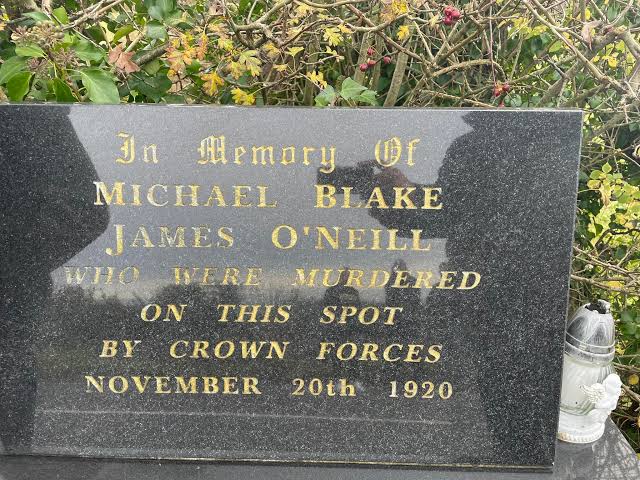
Also on 20 November 1920, two men connected with an earlier murder prosecution were killed while returning home from Dublin after an acquittal.
James O’Neill and Patrick Blake had been accused of involvement in the killing of RIC Constable Walter Oakley but were acquitted by court martial. As their families travelled home, O’Neill was seized near Limerick Junction by armed masked men and later found shot dead. Elsewhere, near Oola, Michael Blake, Patrick Blake’s brother, was taken from the family party and shot dead.
The killings were widely believed to have been carried out by members of the Crown forces or their associates and became another example of the increasingly blurred boundary between official counter-insurgency and unofficial reprisal.
1921 — Belfast Violence Continues as Craig Questions the Treaty Negotiations
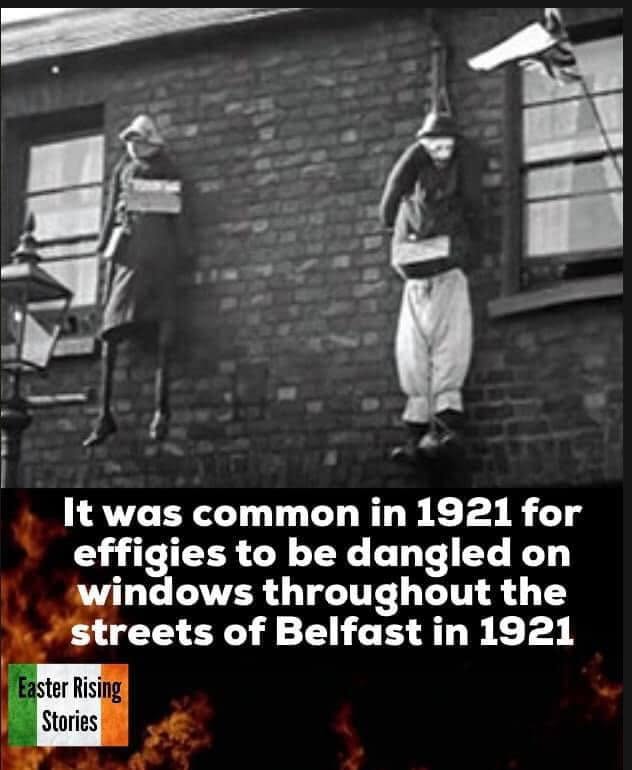
On 20 November 1921, serious disturbances continued in the Ballymacarrett district of Belfast. The violence formed part of an especially bloody period between 19 and 25 November, during which historians estimate that approximately thirty people were killed across the city.
On the same day, Northern Ireland Prime Minister James Craig wrote to Lloyd George seeking clarification on whether Sinn Féin was prepared to accept allegiance to the Crown without conditions, or whether this depended upon Northern Ireland agreeing to an all-Ireland parliament.
The episode illustrates how the Treaty negotiations in London were unfolding at the same time as lethal communal violence continued on the streets of Belfast.
1922 — Bonar Law’s New Parliament Meets
On 20 November 1922, the newly elected British Parliament assembled following the general election that had returned Bonar Law as Prime Minister.
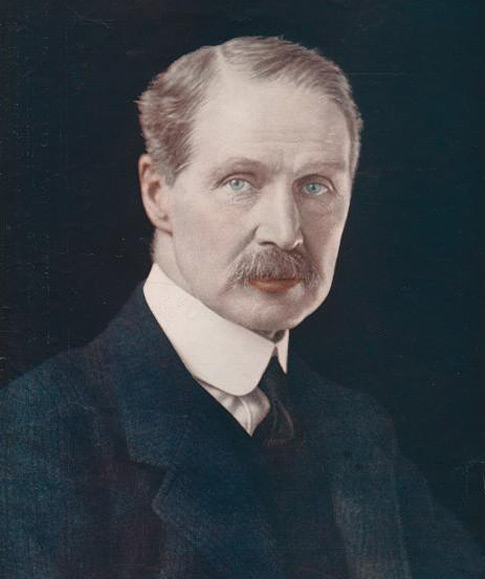
One of its most urgent responsibilities was completing the legislation required to establish the Irish Free State by 6 December 1922. The Irish Free State Constitution Bill and the Irish Free State (Consequential Provisions) Bill were formally introduced on 24 November, with their principal Commons debates beginning on 27 November.
The consequential legislation also dealt with the increasingly separate constitutional position of Northern Ireland. Contrary to some later summaries, the Council of Ireland was not simply abolished at this point; its operation was effectively suspended while alternative arrangements were left to the two Irish administrations.
1923 — Denis “Denny” Barry Dies on Hunger Strike
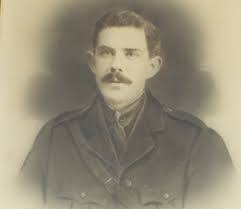
On 20 November 1923, republican prisoner Denis “Denny” Barry, also known as Donnacha de Barra, died in the Curragh Military Hospital after 34 days on hunger strike. Born at Cullen, Riverstick, County Cork, in 1883, Barry had been active in Sinn Féin and the Irish Volunteers before becoming a senior figure in the Cork IRA.
Barry had been interned after opposing the Anglo-Irish Treaty. He was held at Newbridge Internment Camp, where republican prisoners joined the mass hunger strike of autumn 1923 in protest against continued detention without trial and prison conditions. As his health deteriorated he was transferred to the Curragh Military Hospital on 19 November and died the following morning.
Barry had previously played an important role in the Republican Police in Cork, including attempts to restore order and recover property following the Burning of Cork. After his death, the Free State authorities initially buried him at the Curragh. His family subsequently obtained legal authority to recover his remains, and he was reinterred in the Republican Plot at St Finbarr’s Cemetery, Cork.
1933 — Death of Augustine Birrell
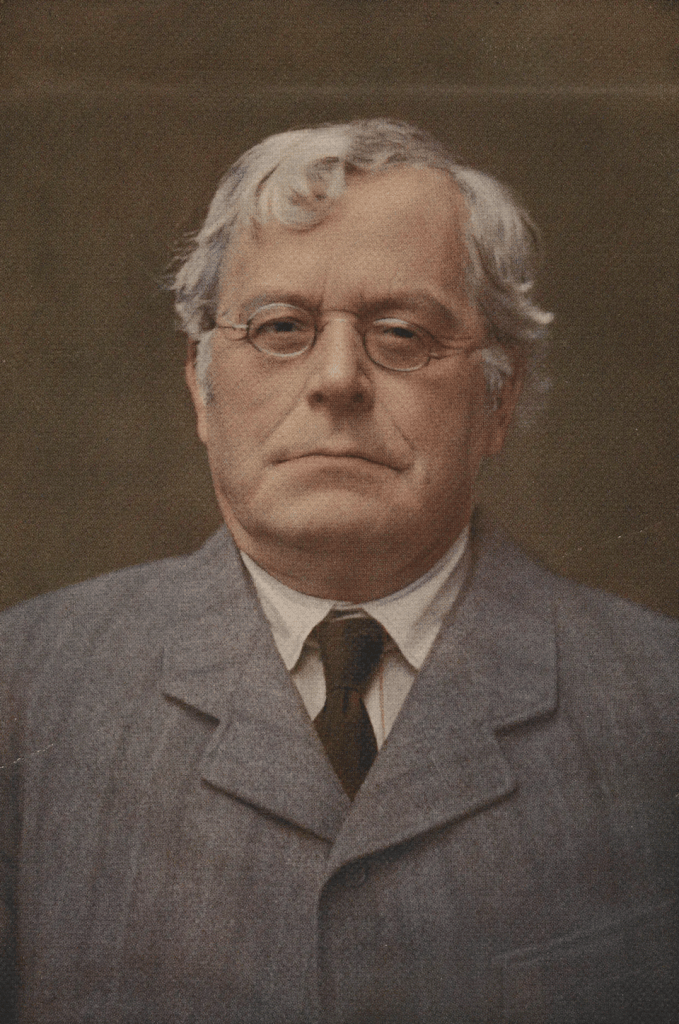
On 20 November 1933, former Chief Secretary for Ireland Augustine Birrell died in London aged 83.
Birrell had served as Chief Secretary from 1907 until May 1916, making him one of the longest-serving holders of the office. His tenure included important reforms, particularly the Irish Universities Act of 1908, but it was ultimately overshadowed by the Easter Rising.
Birrell had underestimated the growing revolutionary threat during the First World War and resigned after the Rising, accepting political responsibility for the failure of the British administration to anticipate the insurrection. His career spans the final phase of attempted constitutional reform before the Irish revolutionary period transformed British-Irish relations.
References
Dictionary of Irish Biography (2009) ‘Birrell, Augustine’. Royal Irish Academy. Available at: https://www.dib.ie/biography/birrell-augustine-a0679
RTÉ/Century Ireland (2020) ‘Body of kidnapped priest found “shot through the brain” in Galway bog’. Available at: https://www.rte.ie/centuryireland/articles/body-of-kidnapped-priest-found-shot-through-the-brain-in-galway-bog
RTÉ Brainstorm (2020) ‘The strange, gruesome murder of a Galway priest 100 years ago’. Available at: https://www.rte.ie/brainstorm/2020/1113/1177739-fr-michael-griffin-galway-murder-november-1920/
Irish History 1919–1923 Chronology (n.d.) ‘November 1920’. Available at: http://irishhistory1919-1923chronology.ie/november_1920.htm
O’Halpin, E. and Ó Corráin, D. (2020) The Dead of the Irish Revolution. New Haven and London: Yale University Press.
Irish History 1919–1923 Chronology (n.d.) ‘November 1921’. Available at: http://irishhistory1919-1923chronology.ie/november_1921.htm
House of Commons Library (2023) Parliament and Northern Ireland, 1921–2021. London: House of Commons Library. Available at: https://researchbriefings.files.parliament.uk/documents/CBP-8884/CBP-8884.pdf
UK Parliament (1922) ‘Irish Free State Bills’, Hansard, House of Commons, 24 November. Available at: https://hansard.parliament.uk/Commons/1922-11-24/debates/66a4278b-b85d-40b8-8480-d25bfff5f37d/CommonsChamber
UK Parliament (1922) ‘Irish Free State Constitution Bill’, Hansard, House of Commons, 27 November. Available at: https://hansard.parliament.uk/Commons/1922-11-27/debates/e625d847-1364-4ca5-929d-591b6fc50c0d/IrishFreeStateConstitutionBill
UK Parliament (1922) ‘Irish Free State (Consequential Provisions) Bill’, Hansard, House of Commons, 27 November. Available at: https://api.parliament.uk/historic-hansard/commons/1922/nov/27/irish-free-state-consequential-1
West Cork People (2023) ‘Remembering Denis Barry’. Available at: https://westcorkpeople.ie/history-folklore/remembering-denis-barry/
Cork Independent (2023) ‘Recasting Cork: The death of Denis Barry’. Available at: https://www.corkindependent.com/2023/11/29/recasting-cork-the-death-of-denis-barry/
Irish History 1919–1923 Chronology (n.d.) ‘November 1923’. Available at: http://irishhistory1919-1923chronology.ie/november_1923.htm


Leave a Reply