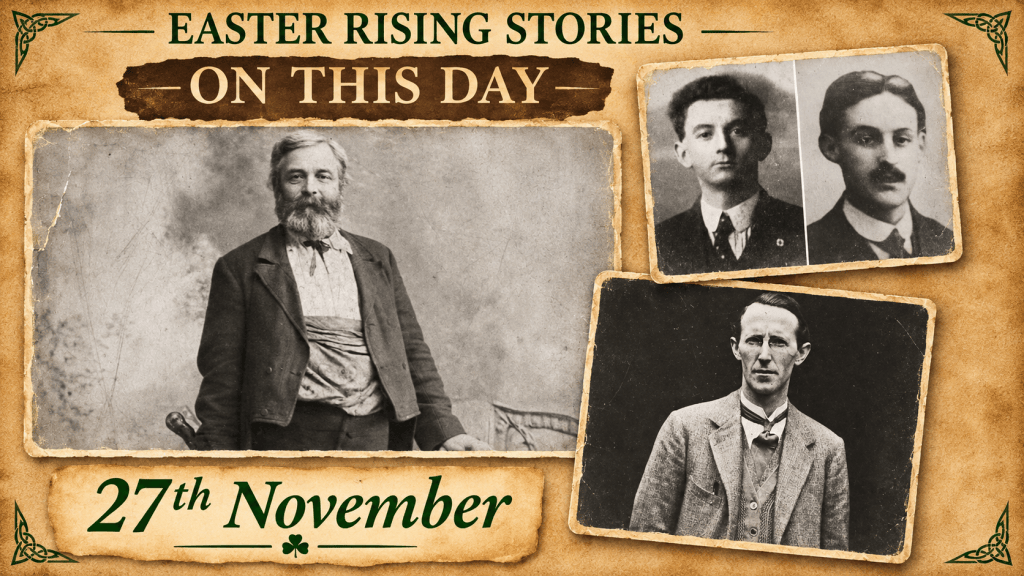
1906 — Death of Michael Cusack, Founder of the GAA
Michael Cusack, teacher, sportsman and one of the principal founders of the Gaelic Athletic Association (GAA), died in Dublin in late November 1906, aged 59. Born at Carron, County Clare, in 1847, Cusack became an enthusiastic advocate for the revival and preservation of traditional Irish sports.
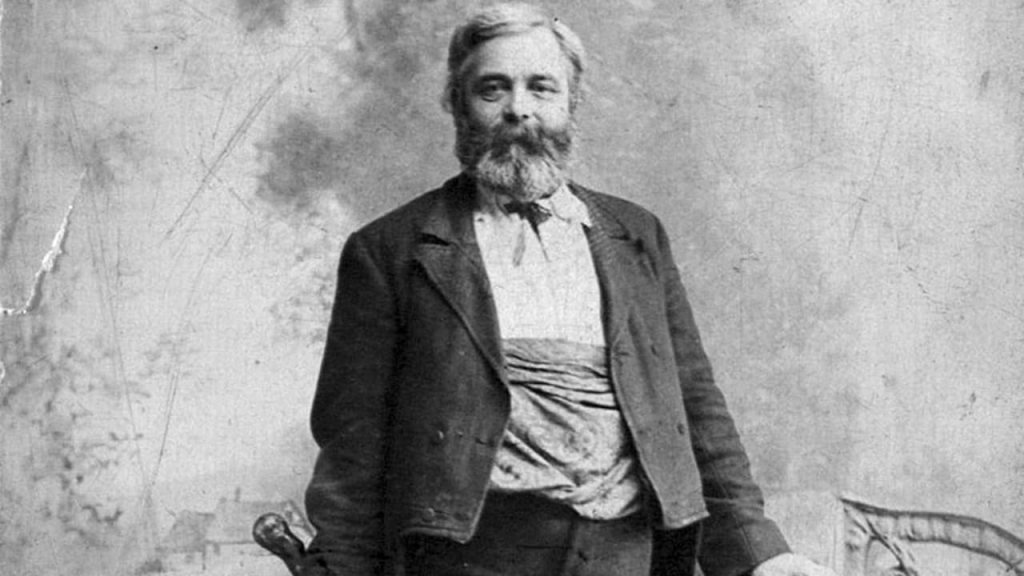
On 1 November 1884, Cusack and Maurice Davin convened a meeting at Hayes’ Hotel in Thurles, County Tipperary, at which the GAA was established. Although disagreements with other officials led to Cusack’s removal as secretary in 1886, he lived to witness the organisation’s expansion throughout Ireland. He was buried in Glasnevin Cemetery, and his contribution to Irish sporting life is commemorated by the Cusack Stand at Croke Park.
Historical note: The Dictionary of Irish Biography and Clare Libraries give his date of death as 27 November 1906, while the University of Galway’s archival catalogue records 28 November.
1920 — Victims of Bloody Sunday Laid to Rest
The days following Bloody Sunday, 21 November 1920, were marked by funerals, religious services and public mourning. Reports on 27 November described the burial of senior IRA officers Dick McKee and Peadar Clancy, who had been laid to rest the previous day following a Requiem Mass at Dublin’s Pro-Cathedral.
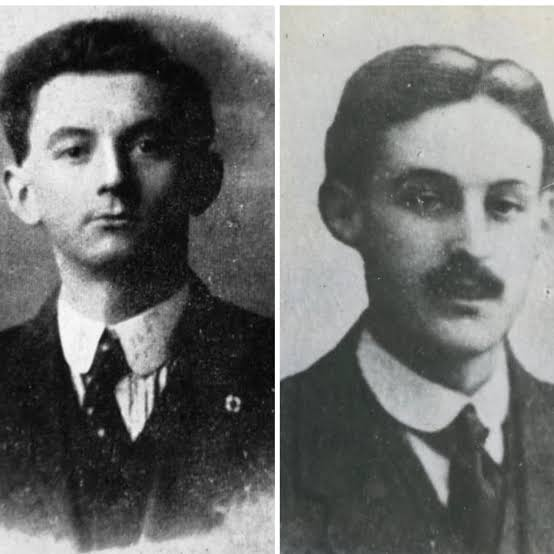
Their coffins were draped in the Irish tricolour and accompanied by fellow Volunteers to Glasnevin Cemetery. Large crowds gathered to pay their respects. Despite the considerable risk of arrest, Michael Collins emerged from hiding to attend the funeral of his former comrades.
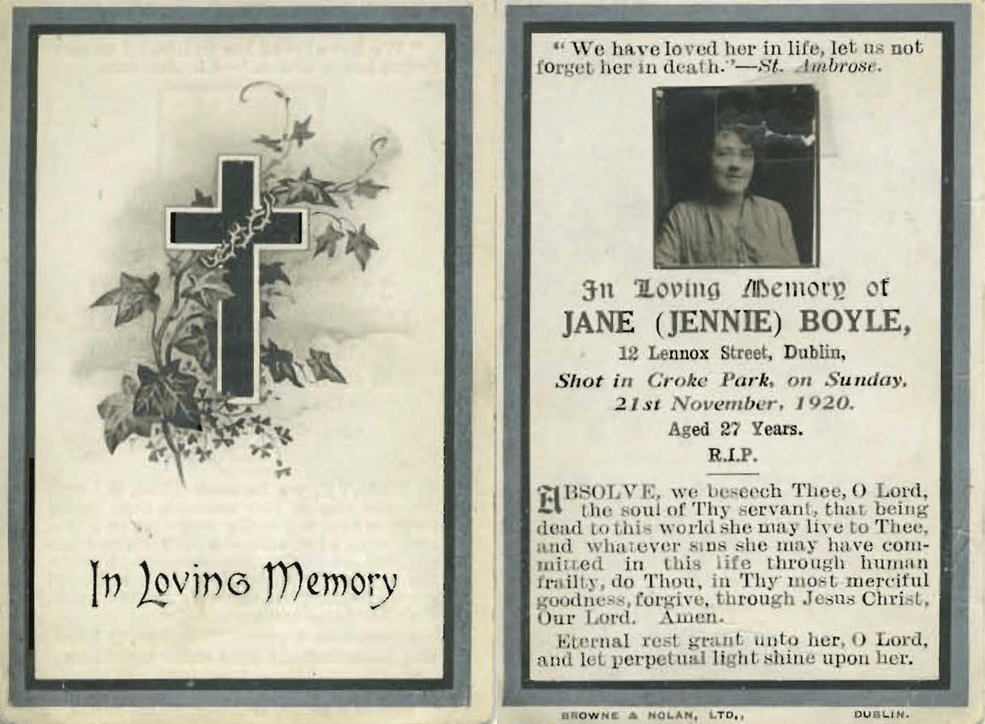
Funeral services were also held for the civilian victims of the Croke Park shootings, including Jennie Boyle and 14-year-old John William Scott. Their deaths highlighted the devastating impact of the violence on ordinary families.
In Britain, memorial services were also held for military personnel killed in Dublin on Bloody Sunday, reflecting the loss experienced on both sides of the conflict.
1920 — RIC Constable Maurice Quirk Shot in Cappoquin
On 27 November 1920, RIC Constable Maurice Quirk was shot by members of the West Waterford IRA in Cappoquin, County Waterford. He died from his wounds two days later.
According to later accounts, the shooting caused resentment among some local IRA members. The incident illustrates the tensions that could arise within republican organisations over attacks on policemen who were known personally within their communities.
1920 — Carnadoe Creamery Burned in County Roscommon
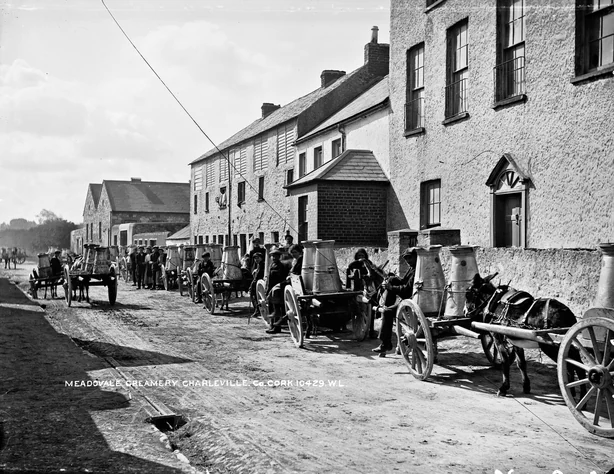
Also on 27 November 1920, Crown forces reportedly burned Carnadoe Creamery and two Sinn Féin halls in County Roscommon following the kidnapping of an RIC constable.
The destruction of creameries during the War of Independence inflicted considerable economic hardship on farming communities. These attacks became a prominent feature of republican publicity concerning British reprisals in Ireland.
1922 — British Parliament Debates the Irish Free State Constitution
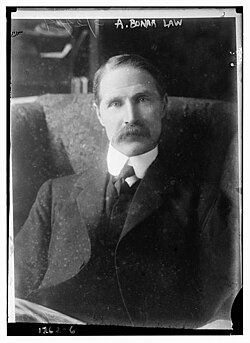
On 27 November 1922, British Prime Minister Andrew Bonar Law introduced the second reading of the Irish Free State Constitution Bill in the House of Commons. British legal advisers had concluded that the Constitution adopted by the Irish parliament was consistent with the provisions of the Anglo-Irish Treaty.
The debate represented one of the final parliamentary stages in establishing the Irish Free State. Despite the continuing Civil War, the new state formally came into existence on 6 December 1922.
1922 — Republican Leadership Escalates Opposition to Executions
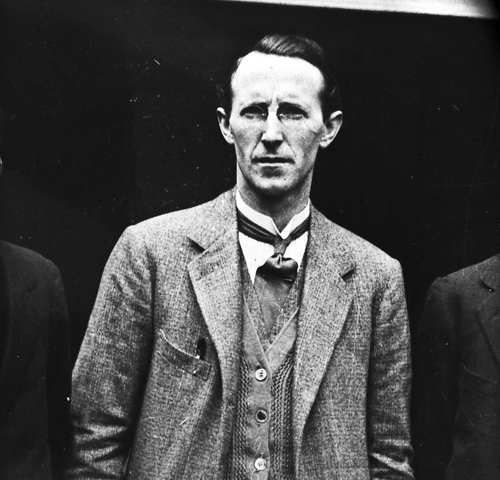
On 27 November 1922, anti-Treaty IRA Chief of Staff Liam Lynch issued a warning to Ceann Comhairle Michael Hayes concerning the government’s execution policy.
Correspondence between Lynch and Éamon de Valera during this period revealed differences over the appropriate republican response to the executions. Although de Valera questioned certain proposed reprisals, he also supported issuing threats against those responsible for the government’s policy.
These developments marked an increasingly bitter phase of the Civil War, as elected representatives and government supporters became potential targets of republican retaliation.
1923 — Free State Government Orders Reductions in Local Authority Wages
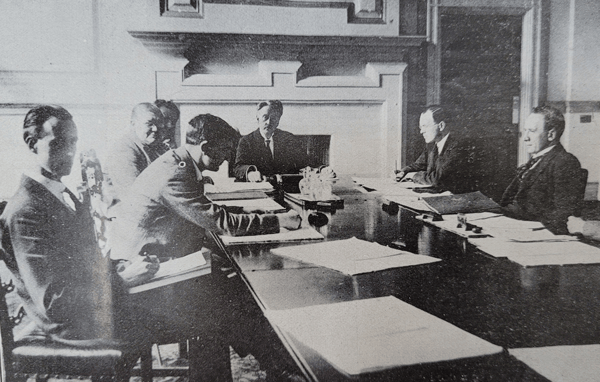
On 27 November 1923, the Minister for Local Government reportedly directed local authorities to reduce labourers’ wages in accordance with prevailing district pay scales.
The measure affected workers employed by local authorities, including road workers, and reflected the financial pressures facing the Irish Free State following the Civil War. Government expenditure reductions and falling wages contributed to economic hardship and industrial unrest during the early years of independence.
References
Dictionary of Irish Biography (2009) ‘Cusack, Michael’. Royal Irish Academy. Available at: https://www.dib.ie/biography/cusack-michael-a2346
Gaelic Athletic Association (2022) ‘Remembering Michael Cusack 175 years after his birth’. Available at: https://www.gaa.ie/news/remembering-michael-cusack-175-years-after-his-birth
Clare Libraries (n.d.) ‘Michael Cusack (1847–1906)’. Available at: https://clarelibraries.ie/localstudies/people/michael-cusack/
University of Galway Archives (n.d.) Papers of Michael Cusack, Collection P95. Available at: https://archivesearch.library.universityofgalway.ie/index.php/papers-of-michael-cusack
RTÉ/Century Ireland (n.d.) ‘Victims of Dublin’s Bloody Sunday laid to rest’. Available at: https://www.rte.ie/centuryireland/articles/victims-of-dublins-bloody-sunday-laid-to-rest
RTÉ History (2020) ‘Shot in Dublin Castle: McKee, Clancy and Clune’. Available at: https://www.rte.ie/history/bloody-sunday/2020/1112/1177751-shot-in-dublin-castle-mckee-clancy-and-clune/
Irish History 1919–1923 Chronology (n.d.) ‘November 1920’. Available at: https://irishhistory1919-1923chronology.ie/november_1920.htm
British Labour Party (1921) Report of the Labour Commission to Ireland. Available at: https://www.academia.edu/6308896/Report_of_the_Labour_Commission_to_Ireland_1921_British_Labour_Party_
O’Halpin, E. and Ó Corráin, D. (2020) The Dead of the Irish Revolution. New Haven and London: Yale University Press.
House of Commons (1922) ‘Irish Free State Constitution Bill’, Hansard, 27 November, vol. 159, cols. 327–387. Available at: https://api.parliament.uk/historic-hansard/commons/1922/nov/27/irish-free-state-constitution-bill
RTÉ (2022) ‘“Take them out and shoot them” – Irish State executions’. Available at: https://www.rte.ie/news/2022/1112/1333890-take-them-out-and-shoot-them-irish-state-executions/
Irish History 1919–1923 Chronology (n.d.) ‘November 1922’. Available at: https://irishhistory1919-1923chronology.ie/november_1922.htm
Irish History 1919–1923 Chronology (n.d.) ‘November 1923’. Available at: https://irishhistory1919-1923chronology.ie/november_1923.htm


Leave a Reply